Select Language:
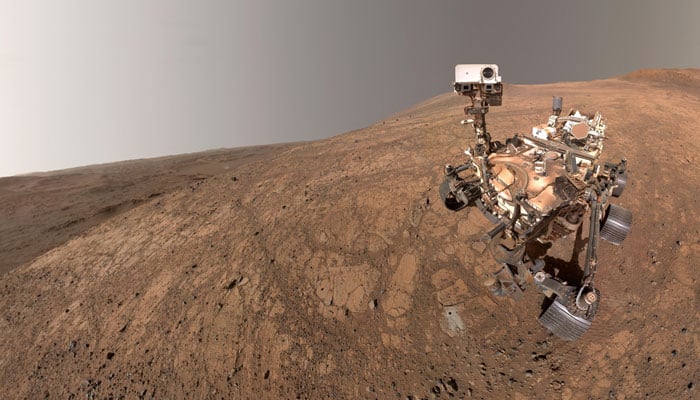
NASA’s Perseverance rover captured this selfie inside Jezero Crater on Mars’s northern hemisphere on May 10, 2025. — Reuters
Washington: The Perseverance rover from NASA has found evidence that Mars’s atmosphere is electrically active, detecting electrical discharges—what some scientists describe as “mini-lightning.” These are often linked to dust devils, which are whirlwinds that frequently drift across the planet’s surface.
Since 2021, the six-wheeled rover has been exploring Jezero Crater in Mars’s northern hemisphere. It identified these electrical discharges through audio and electromagnetic recordings made by its SuperCam remote sensing instrument, scientists revealed.
This marks the first recorded evidence of electrical activity in Mars’s thin atmosphere.
“These discharges represent a major breakthrough, with direct implications for understanding Martian atmospheric chemistry, climate, potential habitability, and future exploration—both robotic and human,” stated Baptiste Chide, a planetary scientist at the Institute for Research in Astrophysics and Planetology in France, who led the study published Wednesday in Nature.
“The electrical charges needed for these discharges probably influence dust movement on Mars, a process critical to the planet’s climate but still not well understood. Moreover, these electrostatic discharges could threaten current robotic systems and may pose risks to astronauts planning to explore the Red Planet someday,” Chide added.
Researchers examined 28 hours of microphone data collected over two Martian years, discovering 55 electrical discharges mostly associated with dust devils and dust storm fronts.
“Lightning as we know it wasn’t detected. These were small sparks—roughly a few millimeters long—not actual lightning. They sounded like sparks or whip cracks,” explained Ralph Lorenz, co-author of the study and planetary scientist at Johns Hopkins University Applied Physics Laboratory.
Sixteen of these discharges occurred during Perseverance’s close encounters with dust devils.
A separate October study showed dust devils are a common feature on the dry, dusty Martian surface, with wind speeds reaching about 98 miles per hour (158 km/h) and lifting dust into the atmosphere.
The internal friction within dust devils generates these electrical discharges. Chide describes it as “mini-lightning,” caused by tiny dust grains rubbing against each other, building up electrons that are suddenly released as electrical arcs just centimeters long, often accompanied by audible shockwaves.
This process, triboelectricity, is similar to static sparks generated when walking on a dry carpet and touching a doorknob on a sunny day.
Long suspected, atmospheric electrical activity on Mars has now been confirmed thanks to highly sensitive instruments that can detect very small discharges—about the energy level of a car’s ignition system.
Mars joins Earth, Saturn, and Jupiter as planets known to have atmospheric electrical phenomena. Other solar system bodies—such as Venus, Uranus, and Saturn’s moon Titan—might also exhibit this feature, the researchers suggest.
Chide noted that Mars’s atmosphere was conducive to electrification: dusty, arid, and turbulent. On Earth’s deserts, dust and sand can become electrified, but actual discharges are rare. On Mars, however, the thin carbon dioxide atmosphere makes such discharges more probable because less charge is needed to produce sparks compared to Earth.
SuperCam, since shortly after Perseverance’s landing in 2021, has been used to listen to and record sounds from Mars, including wind howls, helicopter blades from Ingenuity, and now, electrostatic discharges.
This discovery signifies a new chapter in understanding Mars’s environment—an environment where electrical phenomena are now known to be part of the natural atmospheric processes.
 ChatGPT
 Perplexity
 Gemini AI
 Grok AI