
Select Language:
NASA is preparing to launch four astronauts as early as Wednesday evening on a 10-day mission around the moon. This marks the most ambitious U.S. spaceflight in decades and a significant step toward sending humans back to the lunar surface before China’s first crewed landing.
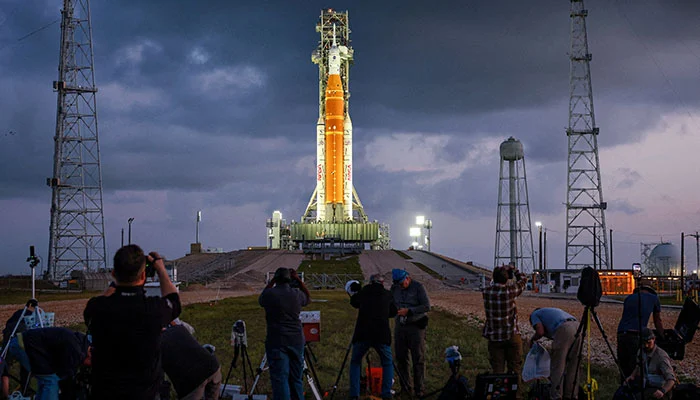
Mission managers at NASA approved the launch for as soon as 6:24 p.m. Eastern Time on Wednesday, using the agency’s 322-foot-tall Space Launch System (SLS) rocket topped with the Orion crew capsule. The launch site is Kennedy Space Center in Florida, just a short distance from where Apollo’s last astronauts took off over 50 years ago.
Astronauts Christina Koch, Victor Glover, Reid Wiseman, and Canadian Jeremy Hansen arrived in Florida last Friday from Houston. They woke about nine hours before launch for breakfast, a weather briefing, and final preparations before heading to the launchpad at 2 p.m. All are in a two-week quarantine leading up to the lift-off, spending time at Kennedy’s beach house — a common pre-flight resting spot for astronauts.
This morning, NASA began loading the SLS core stage with 733,000 gallons of cryogenic fuel to power its four RS-25 engines, which were originally built for the Space Shuttle. Launch officials expressed confidence in current conditions, with only a 20% chance of delays within the two-hour launch window. If weather conditions deteriorate, subsequent launch windows could be available on Friday or later, up to April 6, or even April 30 if necessary.
Originally, the launch was targeted for earlier dates in February and March, but a hydrogen leak caused delays as the rocket was returned to the vehicle assembly building for inspection.
The Artemis II mission will send the crew on a nearly 10-day loop around the moon, traveling approximately 252,000 miles — the furthest humans have ever traveled in space. This surpasses the previous record set by Apollo 13 in 1970, which flew about 248,000 miles but did not land due to an oxygen tank explosion. Since the Apollo missions ended in 1972, humans have not left Earth’s orbit.
In 2022, NASA launched the uncrewed Artemis I mission, which successfully sent the Orion spacecraft around the moon. Artemis II will be a more rigorous test, with astronauts evaluating critical life support, crew interfaces, and communication systems. They will also manually control Orion roughly three hours after launch to test its maneuverability, a vital backup if automated systems fail.
The Orion module is built by Lockheed Martin, while Boeing and Northrop Grumman have led SLS development since 2010, a program known for its high costs—estimated between $2 billion and $4 billion per launch. Meanwhile, private companies like SpaceX and Blue Origin are working on lunar landers to support NASA’s future moon missions.
Artemis II is a crucial step in NASA’s broader Artemis program, which aims for a sustainable presence on the lunar south pole. The agency plans to land crewed missions there by 2028, potentially beating China’s planned lunar landing around 2030. A previous Artemis crewed lunar landing was scheduled as Artemis III, but NASA opted for a preliminary test flight to ensure systems are fully operational before making the historic landing.
 ChatGPT
 Perplexity
 Gemini AI
 Grok AI