
Select Language:
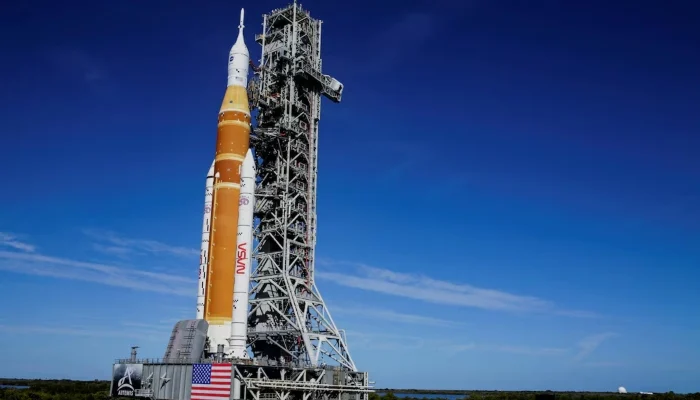
NASA rolled its massive Space Launch System (SLS) rocket towards the launchpad at Kennedy Space Center in Cape Canaveral, Florida, on Saturday morning. This marks the beginning of final preparations for the Artemis II mission, which aims to send four astronauts on a lunar orbit as early as next month.
Moving at a slow pace of about one mile per hour on its mobile platform, the 322-foot-tall (98-meter) SLS exited the Vehicle Assembly Building at sunrise through its giant garage doors and began its 4-mile journey to the launchpad. Hundreds of NASA employees and contractors gathered along the route to observe.
Artemis II mission commander Reid Wiseman spoke from the sidelines, emphasizing the importance of international teamwork and national leadership: “We see collaboration worldwide, and this demonstrates a strong nation guiding the way.” Artemis II astronaut Jeremy Hansen, representing Canada, highlighted the skill and dedication of the American workforce behind this effort.
This upcoming Artemis II mission will be NASA’s second under its multi-billion-dollar lunar program, following an uncrewed test flight in 2022. It will be the first to carry humans around the moon, completing a 10-day journey that pushes the farthest humans have traveled into space.
The crew includes three American astronauts and one Canadian, with a launch targeted for February 6. However, the final date depends on a critical “wet dress rehearsal,” scheduled four days earlier, which simulates the launch countdown to identify any issues before launch.
NASA launch director Charlie Blackwell-Thompson explained the importance of this rehearsal: “The wet dress is the main factor in our schedule. We’ll need time to review the data afterward.” The launch could slip later into February if other logistical factors, such as the rescheduling of Crew-12’s mission to the International Space Station due to an astronaut medical issue, require adjustments.
NASA has planned three launch windows for Artemis II—spanning from February through April—to accommodate precise orbital timings and complex lunar trajectories. These windows open from February 6 to April 11, March 3 to March 11, and April 1 to April 6.
 ChatGPT
 Perplexity
 Gemini AI
 Grok AI