
Select Language:
NASA is preparing to launch four astronauts as early as Wednesday evening on a 10-day mission around the moon, representing the most ambitious U.S. space endeavor in decades and a significant milestone toward returning humans to the lunar surface before China’s first crewed landing.
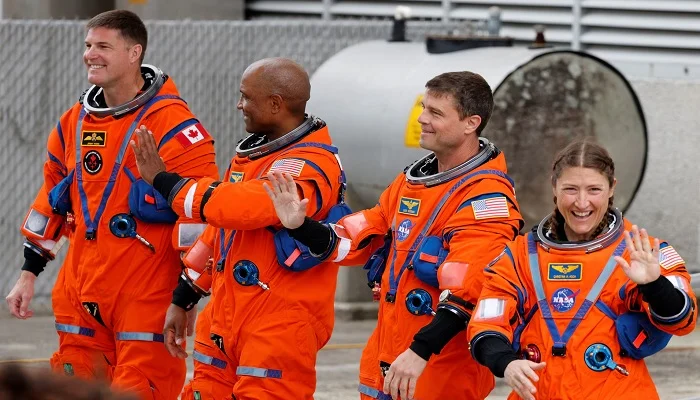
The Artemis II crew, comprising NASA astronauts Christina Koch, Victor Glover, Reid Wiseman, and Canadian astronaut Jeremy Hansen, suited up and arrived at the Kennedy Space Center launch pad ahead of a potential liftoff scheduled as early as 6:24 p.m. EDT (2224 GMT) from Florida’s Kennedy Space Center.
Mission managers gave the green light to proceed with the launch of the massive 322-foot (98-meter) Space Launch System rocket, topped by the Orion crew capsule. Although clouds hovered over Florida’s Space Coast midday, weather forecasts remain 80% favorable for launch.
The launch window extends until 8:24 p.m., with the launch just one pad away from the site where Apollo astronauts left Earth for the moon over 50 years ago.
The crew traveled from Houston to Florida on Friday and spent Wednesday morning about nine hours before launch engaged in breakfast, weather briefings, and pre-mission preparations. They also bid farewell to loved ones before traveling the two miles to the launch pad in armored vehicles.
Leading up to launch, they underwent a two-week quarantine and spent the weekend relaxing at the Kennedy Space Center’s beach house, a designated spot for astronauts prior to departing for space.
Early Wednesday, NASA began fueling the SLS core stage with 733,000 gallons of cryogenic propellant that powers the rocket’s four RS-25 engines. These engines, built by Aerojet Rocketdyne, previously powered NASA’s Space Shuttle for many years.
“Everything is progressing smoothly with the fueling,” said Jeremy Graeber, assistant launch director.
If a last-minute issue or weather setback delays the launch, NASA could attempt to lift off as soon as Friday or as late as April 6. Beyond that date, the earliest opportunity would be April 30.
“All indicators currently point to excellent conditions as we approach countdown,” said launch director Charlie Blackwell-Thompson on Monday.
The mission was initially slated for early February and again in March but was delayed due to a hydrogen leak that prompted a rollback for inspection.
Artemis II will undertake a nearly 10-day journey around the moon, traveling approximately 252,000 miles (406,000 km) away from Earth—the farthest humans have ever traveled in space. The previous record of around 248,000 miles was set by the Apollo 13 crew in 1970 after an oxygen tank explosion prevented a moon landing.
Humans haven’t left Earth’s orbit since the final Apollo mission in 1972. NASA launched the uncrewed Artemis I mission in 2022, sending Orion on a similar lunar orbit.
Artemis II will put Orion and the SLS rocket to a rigorous test. Crews will assess life support systems, interface controls, and communication systems, along with manually piloting Orion about three hours after launch to test its steering if automated controls fail.
Lockheed Martin, the maker of Orion, and Boeing alongside Northrop Grumman, which developed the SLS, have overseen the program since 2010. The project is known for its high costs, estimated between $2 billion and $4 billion per launch.
Competitors like SpaceX and Blue Origin are racing to develop lunar landers for future moon missions.
The Artemis II mission is a pivotal part of NASA’s broader Artemis program, aimed at establishing a sustained presence on the moon’s south pole. The agency plans to land astronauts there by 2028 with Artemis IV, beating China’s planned lunar landing around 2030.
Initially, NASA had planned the Artemis III mission to be the first crewed lunar landing, but new leadership, including Administrator Jared Isaacman, added an extra test flight beforehand to ensure readiness.
 ChatGPT
 Perplexity
 Gemini AI
 Grok AI