Select Language:
Last week, over 100 representatives from international multinational corporations gathered in Beijing for the China Development Forum. Many of them took the opportunity to tour local advanced manufacturing facilities, including companies in electric vehicles, smart appliances, and humanoid robotics, exploring potential future collaborations.
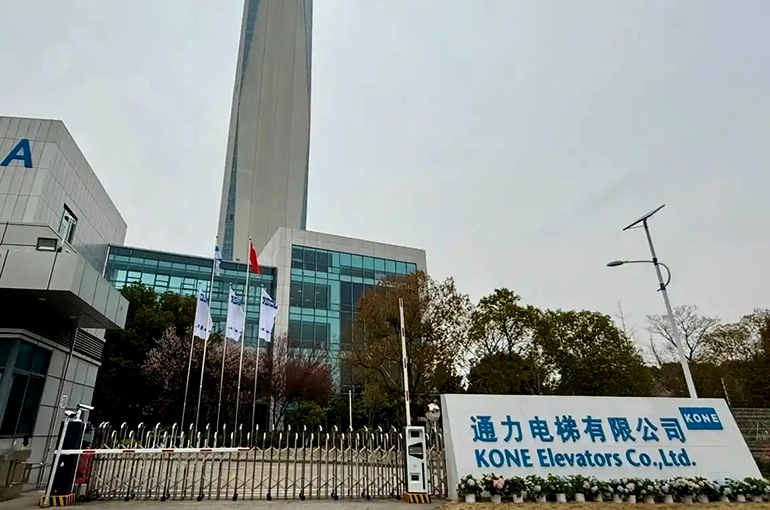
Philippe Delorme, President and CEO of the Finnish elevator company, highlighted that digital transformation, electric vehicles, and robotics are the three key areas of interest within China’s ecosystem. During a recent event celebrating 30 years of presence in China, he mentioned that the company’s digital solutions in the region will be developed entirely based on local technologies and ecosystems.
Kone is increasing its investment in smart manufacturing in China. Its latest next-generation smart elevator platform, unveiled globally in China, features a 22-fold boost in computing power. By connecting seamlessly to various digital ecosystems through multiple open application programming interfaces, it leverages artificial intelligence to shift maintenance approaches from reactive repairs to proactive prevention.
Delorme also emphasized that robotics is a major focus for future growth. The company sees significant potential for robots in the elevator industry, particularly in installation, service, and maintenance, where they could dramatically boost efficiency.
As of last year, more than 140 Chinese companies were involved in researching, developing, and manufacturing humanoid robots, according to the Ministry of Industry and Information Technology. Leading firms like AgiBot and Unitree Robotics have captured the attention of global corporations.
Some of these companies are reportedly constructing large factories to gather data essential for developing AI capable of autonomously controlling robots and machinery. These developments present collaborative opportunities with multinational industrial giants.
During the past week, Siemens’ global head of data and AI visited various Chinese companies, including those specializing in humanoid robots. Xiao Song, Chairman, President, and CEO of Siemens China, remarked that China’s innovation landscape has been rapidly accelerating in recent years, with sectors like embodied intelligence leading globally.
Siemens recently announced a strategic partnership with Alibaba Cloud, integrating Siemens’ simulation tools with Alibaba’s computing resources and infrastructure to deliver computer-aided engineering services tailored for the Chinese market. Such services could attract interest from companies like Unitree Robotics.
The two companies announced this collaboration at Siemens’ first technology conference held in China. By combining Siemens’ simulation portfolio with Alibaba Cloud’s infrastructure, they plan to offer infrastructure-as-a-service solutions for engineering applications, appealing to emerging robotics companies.
Xiao mentioned that embodied intelligence, as a burgeoning technology, still faces challenges related to data availability. “Our extensive industry data holdings are very valuable for emerging fields like embodied intelligence,” he said. “We are actively engaging with industry partners to share data legally, but breaking down data silos remains a significant hurdle.”
 ChatGPT
 Perplexity
 Gemini AI
 Grok AI