
Select Language:
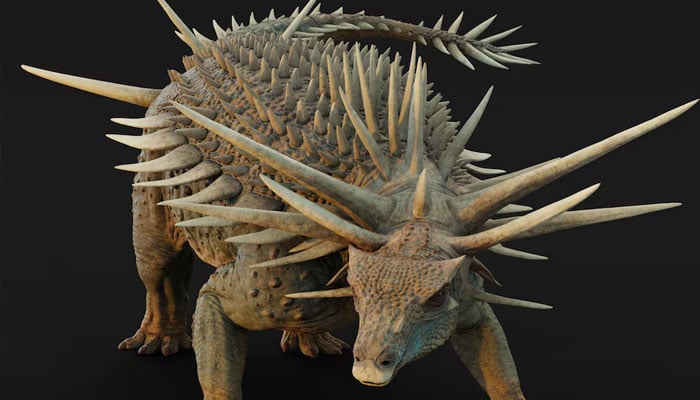
Approximately 165 million years ago, on a coastal floodplain now part of Morocco, thrived one of the most extraordinary dinosaurs ever discovered. This creature was heavily armored and decorated with spikes—some reaching about three feet (one meter) in length—unmatched by any other known dinosaur, according to Reuters.
Recent findings reveal extensive fossilized remains near Boulemane in the Atlas Mountains, showcasing a Jurassic Period dinosaur named Spicomellus. This specimen was roughly 13 feet (four meters) long and likely weighed between one and two tons. It stands as the earliest known member of the armored dinosaur group called ankylosaurs—brovacious, slow-moving herbivores that walked on all fours.
“The armor of Spicomellus is astonishingly strange—completely unlike any other dinosaur or animal we’ve ever uncovered,” stated Richard Butler, a vertebrate paleontologist at the University of Birmingham in England and co-author of the study published in Nature. “It sported a series of long, sharp spikes along its ribs, a feature not seen anywhere else, plus spines comparable to golf clubs protruding in a collar around its neck,” Butler added.
Such elaborate armor might have served dual purposes: protection against large predatory dinosaurs and an attracting display for mates. “While the armor probably provided some defense, it’s hard to see how the meter-long spikes around the neck were functional. They seem excessive,” Butler explained.
Lead researcher Susannah Maidment from the Natural History Museum in London suggested that structures seemingly without clear utility—like antlers or peacock tails—are often linked to sexual selection. “They might have been used in courtship, territorial disputes, or rival battles for mates,” Maidment noted. “However, Spicomellus’ armor is so impractical that it likely evolved for display purposes, possibly related to mating rituals.”
Although the fossils lacked the skull, they provided significant insight into Spicomellus. Previously known only from a single rib fragment described in 2021, additional fossils found in 2022 and 2023 offered a clearer picture. The dinosaur’s back was covered with short spikes formed by spine-covered ribs. It possessed a bony collar with plates, plus two pairs of spikes above the neck, including a prominent 2.85-foot (87 cm) long spike that probably was even longer when alive. Its pelvis was shielded by bony plates, with two large outward-projecting spikes above the hips.
Fused tail vertebrae indicated the presence of a tail weapon—possibly a club or spikes—which was likely used for defense against predators. While not fossilized among the remains, such tail structures are characteristic of ankylosaurs with tail weapons. This suggests tail weapons appeared in ankylosaurs approximately 30 million years earlier than previously thought.
Ankylosaurs were among the most successful herbivorous dinosaurs, descendants of earlier stegosaurs, which bore bony back plates and tail clubs. Both groups originated during the Jurassic period, but ankylosaurs outlived stegosaurs, thriving until an asteroid impact 66 million years ago marked the end of the dinosaurs.
The best-known ankylosaur, Ankylosaurus, was significantly larger than Spicomellus—about 26 feet (8 meters) long—and roamed western North America during the late Cretaceous period. Its formidable armor and tail club safeguarded it from predators like Tyrannosaurus rex.
Early members of dinosaur groups often displayed simpler body structures compared to their descendants. Spicomellus challenges this notion, illustrating that early ankylosaurs already featured highly elaborate armor, including prominent spikes. Butler suggests that later ankylosaurs may have simplified their armor, shifting its primary role to defense as predation increased during the Cretaceous when larger predators emerged.
 ChatGPT
 Perplexity
 Gemini AI
 Grok AI