Select Language:
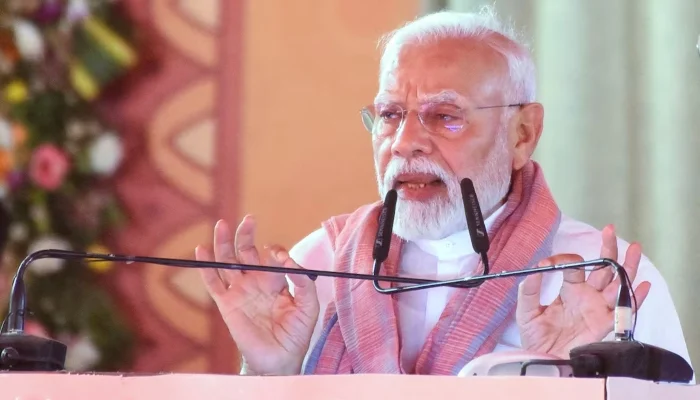
India’s Prime Minister Narendra Modi delivers a speech at a rally in Madhubani, Bihar, on April 24, 2025. — Reuters
– Bihar’s election is critical for Modi’s coalition stability.
– Women voters are especially influential due to male migration for employment.
– Youth unemployment remains a significant concern despite recent declines.
Patna: Next month, Modi’s national alliance faces a challenging regional election in Bihar, driven by issues like youth unemployment and allegations of voter list manipulation, which could threaten his coalition’s hold, especially in a region vital to national politics.
Bihar, a state in eastern India, ranks among the poorest and has a population exceeding 130 million. Its current Chief Minister, Nitish Kumar, has previously aligned with both Modi and opposition parties, but is now a key partner in the NDA.
This state is part of a politically significant heartland, and any fractures within the NDA in Bihar’s November assembly elections could jeopardize Modi’s wider coalition, with upcoming elections in Assam, West Bengal, and Tamil Nadu. While Modi’s alliance holds 293 of 543 seats in Parliament, its strongest support remains in Assam.
Women are increasingly seen as a decisive voting demographic in this tightly contested race. The Vote Vibe agency’s recent poll indicated the NDA holds a narrow 1.6 percentage point lead over the opposition alliance, led by Rashtriya Janata Dal and Congress, as of October 8.
“This election could go either way,” the poll report stated, attributing NDA’s slight advantage to recent social programs, including direct cash transfers to 12.1 million women, totaling over 121 billion rupees ($1.37 billion).
Nivedita Jha, an activist in Patna, emphasizes that women will dominate the voting landscape, as men often leave Bihar to find work in urban hubs like Mumbai and Delhi and aren’t always present for elections.
“Women make decisions because the men are away,” she explains. “They trust the opposition more because it has promised more money if they win.”
Some voters are unhappy with recent changes to the voter list, with cases like 85-year-old Jitni Devi, who was removed and now claims she can’t vote or access her pension.
“They’ve declared me dead,” she told Reuters. “My neighbors tease me as a dead woman, and the bank staff turn me away when I try to withdraw money.”
The state election commission hasn’t commented on Devi’s case, but has assured that all complaints are taken seriously.
Young voters are also frustrated over employment prospects. Despite a reduction in unemployment from 30.9% in 2018-19 to 9.9% in 2023-24 among 15-29-year-olds, concerns persist.
“For me, job issues are the most important because I’ve seen my father leave Bihar for work,” said 25-year-old Babloo Kumar, who plans to vote for the first time.
A new political party, Jan Suraaj, founded by former Modi campaign manager Prashant Kishor, aims to shake up Bihar’s political scene. The party’s leader, Uday Singh, highlights issues like unemployment, migration, rising debts, and declining agricultural revenues, asserting that Modi’s popularity here has waned.
Meanwhile, the opposition is promising to guarantee at least one government job per family, if elected.
Despite the hurdles, Modi’s BJP remains confident. BJP spokesperson Guru Prakash Paswan stated, “The NDA is in a very strong position, with widespread public trust in Prime Minister Narendra Modi’s vision.”
Voting is scheduled for November 6 and 11 across 243 assembly seats, with results announced on November 14.
 ChatGPT
 Perplexity
 Gemini AI
 Grok AI