Select Language:
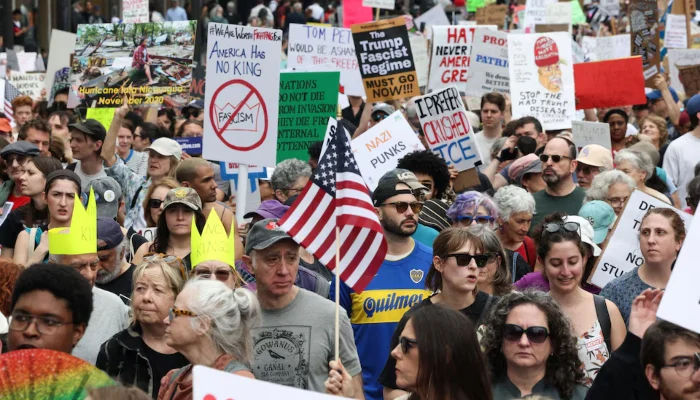
Massive nationwide protests against President Donald Trump are anticipated Saturday as millions express anger over what they perceive as his authoritarian tendencies and other forms of oppressive, law-defying governance.
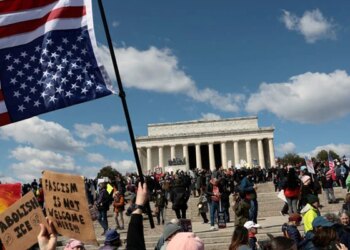
This marks the third time in less than a year that Americans have gathered in the streets as part of the grassroots movement “No Kings,” which has become the most prominent and visible opposition to Trump since he began his second term in January 2025.
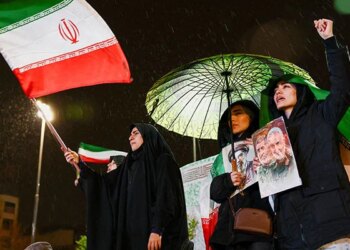
Recently, their outrage has been fueled by the ongoing war in Iran, launched by Trump in coordination with Israel, with constantly evolving objectives and shifting timelines for resolution.
The initial nationwide protest occurred in June on Trump’s 79th birthday, coinciding with a military parade in Washington, which he had insisted be held. Thousands participated from New York to San Francisco and many other locations.
The second “No Kings” protest in October drew an estimated seven million protesters, according to organizers.
The aim now is to mobilize even larger crowds Saturday, as Trump’s approval ratings hover around 40 percent and the upcoming midterm elections in November threaten to result in Republicans losing control of both chambers of Congress.
While many in the “Make America Great Again” movement venerate Trump, the opposing side views him with intense disapproval or even hatred.
Critics condemn his tendency to govern via executive orders, his use of the Justice Department to target political opponents, his support for fossil fuels and climate change denial despite global warming concerns, his opposition to racial and gender diversity initiatives, and his recent display of military strength—campaigning as a peace-maker yet acting as a commander-in-chief of force.
“Nations have been dragged deeper into conflict since the last march,” said Naveed Shah of Common Defense, a veterans’ group aligned with “No Kings.”
“Back home, we’ve seen citizens killed in the streets by militarized forces, families torn apart, and immigrant communities targeted—all under one man’s rule,” Shah added.
Organizers report over 3,000 rallies are scheduled across the country, including major cities, suburbs, rural areas, and even in Kotzebue, Alaska, above the Arctic Circle.
Minnesota is expected to be a focal point, returning to prominence after months of being at the center of debate over Trump’s harsh immigration policies.
Scheduled to perform in St. Paul is Bruce Springsteen, a vocal critic of Trump. He will perform his song “Streets of Minneapolis,” a ballad written and recorded in 24 hours in memory of Renee Good and Alex Pretti, two Americans killed during protests against Trump’s immigration policies in frigid January weather.
The “No Kings” movement states, “Since our first act of defiance in 2025, this movement has grown into a powerful nationwide resistance. We oppose a president trying to rule like a king—costing families their homes, their freedom, and their future.”
They emphasize that about two-thirds of those planning to rally on Saturday do not reside in large cities, many of which tend to be Democratic strongholds. This represents a significant increase from previous protests.
Randi Weingarten, president of the American Federation of Teachers, remarked, “America is at a crossroads. People are scared, struggling to meet basic needs. It’s time for the government to listen, to help build a better future instead of fueling hatred and fear.”
 ChatGPT
 Perplexity
 Gemini AI
 Grok AI