Select Language:
Most major shipping routes are experiencing a decline in sea freight rates due to weak global trade demand. Meanwhile, other markets are stepping in to fill the gap. Freight prices to the Middle East, as well as Australia and New Zealand, are steadily rising, even as rates to Europe and the United States continue to fall.
Since June 13, shipping rates to Europe have been decreasing, and rates to the U.S. have also trended downward, despite a brief uptick on July 11. The causes for these declines differ: in Europe, the economy and demand are recovering, while in the U.S., low freight rates are mainly driven by weak demand caused by high tariffs.
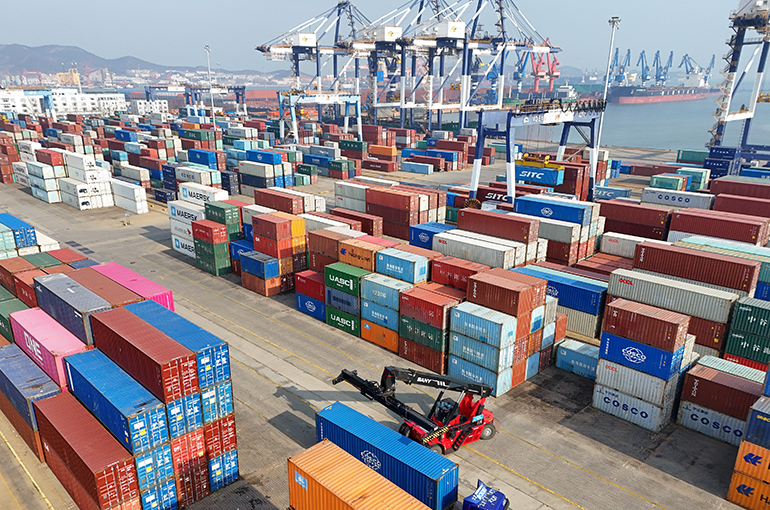
According to the Shanghai Shipping Exchange, the Shanghai Containerized Freight Index dropped 3.1% on August 22, ending the week at 1,415.36 points. On that day, the ocean freight rate—including surcharges—from Shanghai to major European ports fell 8.4% week over week, reaching $1,668 per 20-foot container. Similarly, rates from Shanghai to the U.S. West Coast and East Coast declined by 6.5% and 3.9% per 40-foot container, totaling $1,644 and $2,613, respectively.
“Although freight rates are declining, our shipping volume to Europe has increased,” said Wang Zhicong, marketing director at Shenzhen Baosen Santong Logistics. “However, last week one of our biggest clients, who sells on Amazon, mentioned that the U.S. e-commerce platform has started limiting warehouse space. When clients have less storage capacity locally, they tend to rely more on overseas warehouses,” he added.
Many Chinese exporters have reported a slowdown in orders from the U.S., with clients becoming more cautious and placing shorter-term orders. A China-based exporter focusing on the U.S. market said they currently have bookings only for the next four months, whereas before the tariff disputes, they would have orders stretched out over six months or more.
Despite the declines to Europe and the U.S., routes to the Middle East and Australia-New Zealand are gaining popularity. On August 22, rates from Shanghai to key ports in the Persian Gulf rose 7.1% from the previous week, reaching $1,479 per twenty-foot equivalent unit (TEU). Freight to Australia and New Zealand also increased by 2.3%, hitting $1,267 per TEU — an approximately 85% jump since June 6.
“The Middle East route has experienced the most significant increase. A 40-foot container that cost around $1,100 in July now exceeds $2,000,” explained Zou Zhenhua, a freight forwarder mainly serving emerging markets like India. Larger containers, especially 40-foot units, are in higher demand because consolidating shipments helps reduce costs. Additionally, nearly 60% of exports involve electromechanical products that often require larger or specialized containers.
Zou began expanding into the Middle East earlier this year. Following rising tensions between Israel and Iran in June, demand surged in the region but available shipping space remained tight, causing some delays. As a result, his company is working to further increase capacity.
A manager from a major international freight forwarding company told this publication that, although demand in the Middle East and Australia-New Zealand has grown significantly, their total volume remains much smaller compared to Europe and the U.S. The strategy is to continue supporting business in Europe and the U.S. markets while expanding services for Chinese companies operating globally.
“Traditional Free On Board (FOB) operations are likely to decrease,” she said. “Growth opportunities lie in facilitating Chinese companies establishing factories overseas, including moving raw materials and components, and handling logistics for high-tech products that require more specialized services.”
 ChatGPT
 Perplexity
 Gemini AI
 Grok AI