Select Language:
Viktor Orban, Hungary’s longtime nationalist leader, lost his grip on power to the new center-right Tisza Party in Sunday’s national elections after 16 years in office. This defeat marks a significant setback for his supporters in Russia and the White House under President Donald Trump.
At 62, Orban was praised across Europe and the U.S. as the architect of the “illiberal” democratic model. However, his popularity waned domestically as voters grew tired of sluggish economic growth, global isolation, and the rise of oligarchs accumulating wealth.
His decisive loss gave Tisza’s Peter Magyar, 45, a strong majority in Hungary’s 199-seat parliament, paving the way for substantial reforms. Critics in the European Union argued that Orban’s previous governance had undermined democratic standards.
With nearly all votes tallied, Tisza was projected to secure 138 seats—more than the two-thirds majority needed to reverse Orban’s constitutional changes and tackle corruption. Sunday’s record-high turnout showed how deeply Hungarians viewed this election as a pivotal moment.
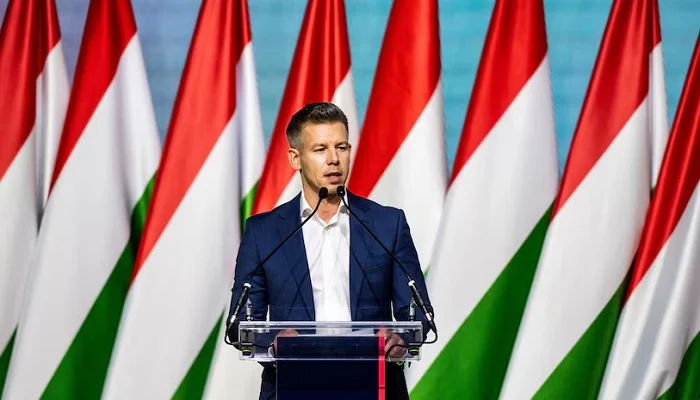
Magyar told tens of thousands of supporters along Budapest’s Danube River embankment, “We did it. Tisza and Hungary have won this election,” as supporters danced and cheered. Many held candles as Sinatra’s “My Way” played, and Magyar declared, “Together, we’ve replaced Orban’s system, liberated Hungary, and reclaimed our country.”
Magyar framed the election as a choice between “East and West,” warning that Orban’s confrontational approach toward Brussels could steer Hungary further away from European integration. Orban responded that Tisza would drag Hungary into an unwanted conflict with Russia—a claim Magyar denied.
“While the result hurts us, it’s unmistakably clear,” Orban said from Fidesz’s campaign headquarters. Some supporters mourned outside, crying as they watched his speech on TV.
The end of Orban’s 16-year rule is expected to have broad implications beyond Hungary—affecting the European Union, Ukraine, and international relations. Many EU leaders hope that Hungary’s previous antagonistic stance will soften, potentially unlocking a €90 billion ($105 billion) aid package for Ukraine that Orban blocked.
Analyst Mujtaba Rahman from Eurasia Group said Magyar is positioned to follow through on vows to curb corruption and remove Fidesz loyalists from key positions. “Regarding Ukraine, Magyar appears ready to facilitate the transfer of €90 billion to Kyiv. Pre-election caution has eased, and Hungary is likely to gradually align more closely with EU norms on most issues,” Rahman explained.
Some Brussels diplomats noted that issues like migration remain challenging, but they see Hungary as a partner with whom they can work.
Ukrainian President Volodymyr Zelensky congratulated Magyar, expressing readiness to collaborate on strengthening Europe and maintaining peace. “A constructive approach has triumphed,” Zelensky tweeted.
Orban’s departure could also allow Hungary to access EU funds suspended over concerns about democratic backsliding—a development closely watched by financial markets.
European Commission President Ursula von der Leyen reflected, “Hungary has chosen Europe. Europe has always chosen Hungary,” after partial election results surfaced.
His exit also signifies the loss of a key EU ally for Russia’s Vladimir Putin and would send shockwaves through Western right-wing circles, including the White House.
Orban had garnered support from the Trump administration, highlighted by Vice President JD Vance’s recent visit to Budapest, as well as backing from Moscow and far-right factions across Europe. However, allegations of government collusion with Moscow during his campaign challenged his image, which he denied, asserting his focus on protecting Hungarian identity and Christian values within a secure EU environment.
A 24-year-old supporter named Dorina Nyul expressed excitement, saying, “This feels like our only real chance in a long time to actually change the system. I can’t even describe how it feels.”
 ChatGPT
 Perplexity
 Gemini AI
 Grok AI