Select Language:
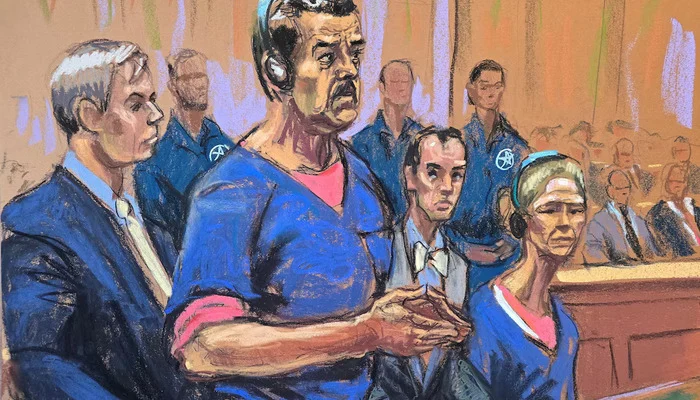
Venezuela’s detained President Nicolás Maduro and his wife, Cilia Flores, appear in court with defense attorneys Barry Pollack and Mark Donnelly to face federal charges in the United States, including narco-terrorism, conspiracy, drug trafficking, money laundering, and other allegations. The proceedings took place at the Daniel Patrick Moynihan U.S. Courthouse in Manhattan, New York City, on January 5, 2026, as depicted in a courtroom sketch. — Reuters
– The credibility of witnesses plays a significant role in the trial.
– Two out of three convictions have been overturned.
– Maduro faces charges related to drug trafficking conspiracy.
Ousted Venezuelan President Nicolás Maduro is appearing again before a U.S. court Thursday, facing serious criminal allegations, including narcoterrorism—a rarely tested statute with a limited history of successful prosecutions.
Maduro, 63, governed Venezuela from 2013 until he was captured in Caracas by U.S. special forces on January 3. He entered a plea of not guilty on January 5 to all charges brought against him in the United States.
The law under scrutiny, enacted in 2006, targets drug trafficking connected to activities that the U.S. classifies as terrorism. According to a Reuters review of federal court records, only four individuals have been convicted under this statute, with two convictions later reversed due to issues involving witness credibility.
This mixed record illustrates one of the main hurdles prosecutors face: convincing a jury that evidence from cooperating insiders reliably links drug activities to terrorism.
“The key takeaway from these past cases isn’t that the narcoterrorism law is unworkable,” stated Alamdar Hamdani, a partner at Bracewell law firm and former U.S. Attorney in Houston. “It’s that proving a defendant’s knowledge of a terrorism nexus requires evidence of exceptional quality and prosecutorial diligence, leaving no room for mistakes or unverified witness statements.”
Prosecutors have not yet revealed who will testify against Maduro, but a former Venezuelan general indicted alongside him has expressed willingness to cooperate, according to Reuters.
### Maduro Accused of Supporting Colombian Rebels
The narcoterrorism law was created two decades ago to prosecute drug traffickers financing activities considered terrorism by the U.S. Since then, 83 people—including Maduro—have faced charges under this law. Thirty-one have pleaded guilty to narcoterrorism or lesser charges, eight are awaiting trial, and many are outside U.S. custody, based on the review.
Although some convictions have been overturned, this does not impact Maduro’s case, and he faces additional charges, including conspiracy to import cocaine.
A socialist, Maduro is accused of orchestrating a conspiracy where his government officials aided in moving cocaine through Venezuela, collaborating with traffickers such as the Revolutionary Armed Forces of Colombia (FARC), designated as a terrorist organization by the U.S. from 1997 to 2021. Maduro and his associates have always denied any wrongdoing, claiming the charges are part of an imperialist plot to harm Venezuela.
His attorney, Barry Pollack, has not responded to inquiries about the history of narcoterrorism trials or potential witnesses. The Manhattan U.S. Attorney’s Office also declined to comment.
### Broad Definition of Terrorism in Law
Narcoterrorism carries a mandatory minimum sentence of 20 years, twice the standard penalty for typical drug trafficking, and can lead to life imprisonment. The law defines terrorism as premeditated, politically motivated violence targeting civilians.
“Legal definitions of terrorism and terrorist acts are broad,” explained Shane Stansbury, a law professor at Duke University and former federal prosecutor.
To secure a conviction, prosecutors must demonstrate that Maduro knew his drug trafficking activities profited a group engaged in terrorist acts, regardless of his intent or motivations.
“Conviction does not require proof of motive,” added Artie McConnell, a former federal prosecutor now with BakerHostetler.
Historically, attempts to prosecute individuals under this statute have resulted in mixed outcomes. For instance, in 2008, an Afghan man with alleged Taliban links was convicted of aiding a DEA informant in purchasing opium and heroin; however, a 2021 appeals court vacated his narcoterrorism conviction due to insufficient challenge of the sole witness linking him to the Taliban. Similarly, a 2011 case against an Afghan trafficker ended in deadlock; he was retried and convicted in 2012, but his narcoterrorism charge was later dismissed after evidence was discredited. Conversely, in recent years, convictions for drug trafficking involving FARC and Colombia have been upheld.
### Reliance on Cooperating Witnesses
Legal analysts suggest the government may use testimony from two former Venezuelan generals, Cliver Alcalá and Hugo Carvajal, indicted in 2020. Both have pleaded guilty to charges related to their dealings with FARC but have not cooperated at the time of their pleas.
In a phone interview from a Maryland prison, Alcalá stated his willingness to cooperate but criticized prosecutors for insisting he admit to drug trafficking—something he denies—before backing cooperation.
Alcalá, a former Venezuelan military officer, retired after Maduro assumed office and later became an outspoken critic. He is serving nearly 22 years after pleading guilty to supporting FARC with weapons, which he claims he did under orders from the late Venezuelan leader Hugo Chávez, but denies aiding drug traffickers.
Carvajal’s sentencing is scheduled for April 16. His legal representatives have not indicated whether he will cooperate.
 ChatGPT
 Perplexity
 Gemini AI
 Grok AI