Select Language:
- US to oversee Venezuela until ‘safe, proper, judicious transition’: Trump
- Venezuela’s top court orders Vice President Rodriguez to assume the presidency.
- US military reports over 150 aircraft involved in Maduro’s capture mission
Venezuelan President Nicolas Maduro was detained in a New York jail on Saturday, shortly after U.S. special forces seized and evacuated him from his country. President Donald Trump claimed that control of Venezuela would effectively shift to the United States.
The announcement followed a swift pre-dawn raid where commandos abducted Maduro and his wife while airstrikes targeted locations in and around Caracas.
A U.S. military aircraft carrying Maduro landed at a military base after nightfall before transferring him by helicopter to New York City, where he and his wife are set to face drug trafficking and weapons charges.
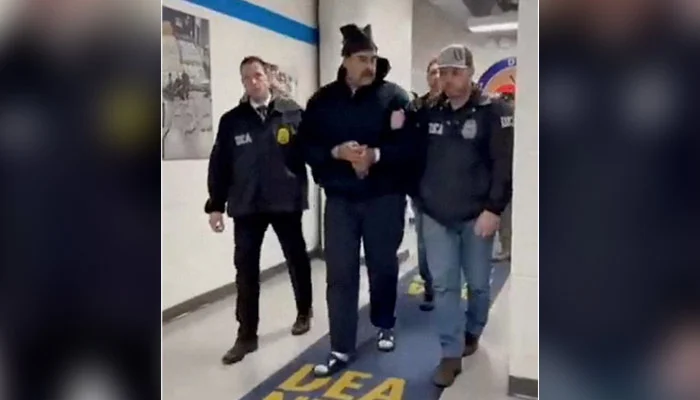
The White House released a video on X of Maduro, in handcuffs and sandals, being escorted through a DEA facility in New York. In the clip, the 63-year-old leftist can be heard saying, “Good night, happy new year,” in English.
Although the operation was successful, future developments remain uncertain.
Trump indicated that cabinet members are being designated to manage Venezuela, but offered no detailed plans. He also hinted at the potential deployment of troops, stating that the U.S. is “not afraid of boots on the ground.”
He expressed a preference to work with Maduro’s Vice President, Delcy Rodriguez, rather than support opposition forces taking power.
Trumps’s interest in Venezuela’s oil reserves was evident, as he stated, “We’re going to have our large American oil companies go in, invest billions of dollars, and repair the badly damaged infrastructure. We will be exporting significant amounts of oil.”
Opposition leader dismissed
Maria Corina Machado, an opposition leader backed by the U.S. and recently awarded the Nobel Peace Prize, posted on social media that “the time for freedom has arrived.” She called for Edmundo Gonzalez Urrutia, the opposition’s 2024 presidential candidate, to take office immediately.
Trump dismissed Machado’s chances, claiming she lacks “support or respect” in Venezuela. Instead, he praised Rodriguez, saying she is willing to do what’s necessary to “make Venezuela great again.”
Venezuela’s Supreme Court later ordered Rodriguez to assume presidential powers in an acting capacity. The situation reflects ongoing political instability.
Trump suggested that U.S. involvement in Venezuela may continue for some time, stating, “We will stay until the proper transition process is complete.”

Venezuela’s allies condemned the operation. China issued a strong condemnation, while France emphasized that solutions must not be imposed externally. UN Secretary-General Antonio Guterres expressed deep concern over what he called violations of international law.
The UN Security Council is scheduled to meet Monday at Venezuela’s request to discuss the crisis, according to the Somali presidency of the Council.
Airstrikes and power outages
Venezuelans prepared for possible attacks as US forces gathered offshore for months. Residents of Caracas woke early to explosions and helicopters overhead around 2:00 a.m. local time. Airstrikes targeted a military base and other strategic sites for nearly an hour.
According to General Dan Caine, over 150 aircraft supported the operation, helping troops airlifted in to detain Maduro based on months of intelligence—including details about his daily routine, diet, and pets.

Maduro and his wife reportedly surrendered without resistance, with no U.S. casualties. Trump mentioned to the New York Post that many Cubans assigned to Maduro’s security were killed in the operation.
Following the raid, Caracas was unusually quiet, with police patrols outside government buildings and smoke filling the air.
Shifting narratives
The United States and many European nations refused to recognize Maduro’s presidency, accusing him of election fraud in 2018 and 2024. Maduro, who has been in power since 2013 after succeeding Hugo Chavez, has long accused Trump of attempting regime change to control Venezuela’s oil supplies.
Trump has justified his hardline stance—citing issues like illegal migration, drug trafficking, and oil interests—although he previously avoided explicitly calling for Maduro’s ouster.
Many members of Congress questioned the legality of the operation, but House Republican leader Mike Johnson defended it, calling it “justified.”
 ChatGPT
 Perplexity
 Gemini AI
 Grok AI