
Select Language:
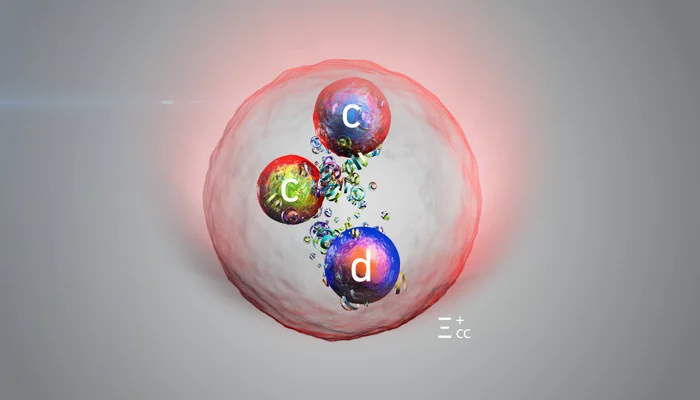
The Large Hadron Collider has detected a new subatomic particle, marking its 80th discovery thus far by the world’s most powerful particle accelerator at CERN in Europe, announced Tuesday. This particle has been named “Xi-cc-plus.” Scientists believe it, which is akin to a proton but four times as heavy, could shed light on some of the more perplexing aspects of quantum mechanics.
All matter surrounding us—including protons and neutrons within atomic nuclei—is classified as baryons. These particles are made up of three quarks, which are the fundamental constituents of matter. Quarks exist in six types, or “flavors”: up, down, charm, strange, top, and bottom. Each flavor varies in mass, electric charge, and other quantum characteristics.
Theoretically, there could be numerous baryons composed of different combinations of these flavors, but most are extremely challenging to observe due to their fleeting existence. To explore these elusive particles, the collider accelerates particles in an underground ring, smashing them together at incredible speeds. These high-energy collisions provide brief opportunities for researchers to analyze decay patterns of the resulting particles and infer their properties.
The newly identified “Xi-cc-plus” contains two charm quarks and a down quark. In contrast, standard protons have two up quarks and one down quark. Since the new particle replaces the lighter up quarks with heavier charm quarks, it has a significantly greater mass. Vincenzo Vagnoni, spokesperson for CERN’s LHCb experiment, noted that this is only the second time a baryon with two heavy quarks has been observed. He also highlighted that this is the first new particle discovered after upgrades to the LHCb detector, completed in 2023.
This discovery will assist theorists in testing and refining models of quantum chromodynamics — the theory describing the strong force that binds quarks together into baryons, mesons, and other exotic hadrons like tetraquarks and pentaquarks. Back in 2017, the same experiment reported the discovery of a similar particle made of two charm quarks and one up quark. However, the new particle has an estimated lifetime six times shorter, making it considerably more difficult to detect.
The CERN Large Hadron Collider is a 27-kilometer (17-mile) ring located roughly 100 meters underground beneath France and Switzerland. Besides its famous 2012 discovery of the Higgs boson, often called the “God particle,” it continues to probe the fundamental particles and forces of the universe.
Looking ahead, CERN plans to develop an even larger collider, known as the Future Circular Collider, to deepen our understanding of the universe’s mysteries.
 ChatGPT
 Perplexity
 Gemini AI
 Grok AI