Select Language:
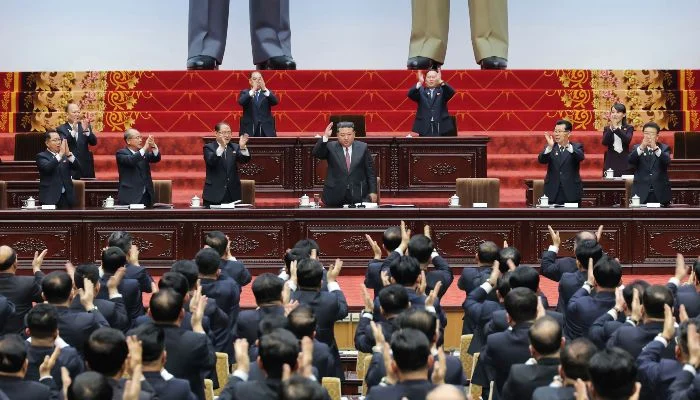
North Korea’s legislature has re-elected Kim Jong Un as the country’s leader, according to state media reports on Monday. The announcement was made by KCNA, North Korea’s official news agency. Kim’s reappointment as chairman of the State Affairs Commission, which is the highest policymaking and governing body, was confirmed during the first session of the 15th Supreme People’s Assembly.
Critics argue that elections in North Korea are heavily scripted, serving more as a show than an actual democratic process. KCNA stated, “The Supreme People’s Assembly of the DPRK reelected Comrade Kim Jong Un as President of the State Affairs of the Democratic People’s Republic of Korea during the First Session, marking the start of the 15th term.” The report added that this decision reflected the “unanimous will and desire of all the Korean people.”
Kim, a third-generation ruler of the nuclear-armed nation founded by his grandfather Kim Il Sung in 1948, has been in power since 2011 following his father’s death. Experts such as Lee Ho-ryung from the Korea Institute for Defense Analyses view these elections as choreographed events with predetermined outcomes. She explained, “North Korea stages such events to project an image of political legitimacy, but no real change is expected.”
Photos depict Kim dressed in a formal Western-style suit, seated centrally on a stage flanked by high-ranking officials, with large statues of his father Kim Jong Il and grandfather in the background.
Ahead of the session, 687 deputies were elected to the assembly, with North Korean voters over 17 years old given the option to approve or reject the single candidate provided by the ruling party. The votes overwhelmingly supported Kim’s re-election, with 99.93% in favor and only 0.07% against, and a turnout of 99.99%, according to KCNA. The assembly was described as densely packed with members demonstrating “extraordinary political awareness and revolutionary enthusiasm.”
Observers suggest that the current session may consider constitutional amendments, potentially including language to formally define inter-Korean relations as those between “two hostile states.” The tone used by Kim regarding South Korea during his speech will serve as an important indicator of his future policies toward the peninsula, according to Hong Min from the Korea Institute for National Unification. He said, “Changes in terminology from ‘reunification’ or ‘Korean unity’ to more aggressive language like ‘territorial control’ could reflect shifts in ideological stance.” The focus will likely be on how he addresses issues of territorial waters and airspace in dealings with Seoul.
This session follows a larger, party-wide meeting held last month, which occurs every five years.
 ChatGPT
 Perplexity
 Gemini AI
 Grok AI