Select Language:
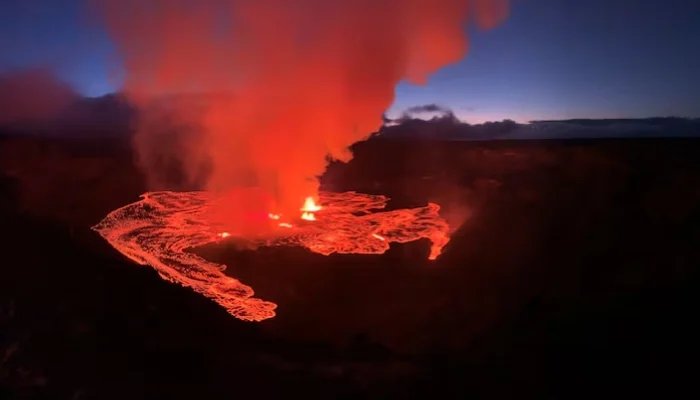
Lava streams across the floor of the Halema’uma’u crater, closely accompanied by several active vents, as Kilauea volcano erupts in Hawaii, U.S., on June 7, 2023. — Reuters
LOS ANGELES: On Saturday, spectacular new lava fountains erupted from Hawaii’s Kilauea volcano, according to U.S. volcanologists. This marks nearly a year since one of the world’s most active volcanoes first started erupting.
The Hawaiian Volcano Observatory of the US Geological Survey reported that “sustained lava fountains approximately 50–100 feet (15–30 meters) tall are currently erupting from the northern vent,” and noted that “fountain heights are increasing rapidly.”
This recent activity— the 38th eruption phase spewing molten rock and gases from deep beneath the surface— began at 8:45 a.m. local time (18:45 GMT), USGS said.
Since the initial eruption on December 23, 2024, activity has fluctuated, typically lasting less than a day, the agency added.
All volcanic activity remains confined within the Halema’uma’u crater inside Hawaii Volcanoes National Park, and local airports are not expected to experience disruptions from volcanic gases or ash.
Officials are monitoring high levels of volcanic gases and a phenomenon known as “Pele’s hair”— strands of volcanic glass often produced during lava fountain activity, which can be carried over 10 miles (15 kilometers) from the vent.
Hot, glassy volcanic fragments can fall within 1–2 miles (1–3 kilometers) of erupted vents.
Kilauea has been highly active since 1983, erupting fairly regularly.
It ranks as one of six active volcanoes in Hawaii, including Mauna Loa, the largest volcano on Earth.
While smaller than Mauna Loa, Kilauea is notably more active and attracts many tourists taking helicopter tours to witness its fiery displays.
 ChatGPT
 Perplexity
 Gemini AI
 Grok AI