Select Language:
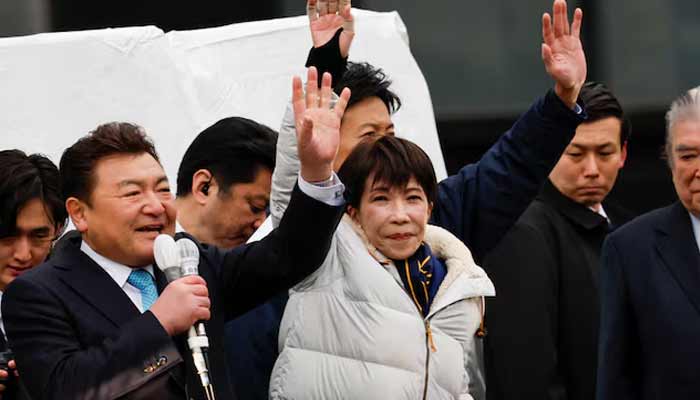
Japan’s Prime Minister Sanae Takaichi, leader of the ruling Liberal Democratic Party (LDP), greets supporters during an election rally before the February 8 snap election in Tokyo on February 7, 2026. — Reuters
The coalition led by Japanese Prime Minister Sanae Takaichi achieved a historic victory in Sunday’s election, opening the door for promised tax reductions that unsettled financial markets.
Takaichi, Japan’s first female Prime Minister and a staunch conservative inspired by Britain’s Margaret Thatcher, was projected to secure up to 328 out of 465 seats in the lower house of Parliament for her LDP.
Less than two hours after voting closed, the LDP surpassed the 233 seats needed for a majority, marking one of its most successful election outcomes ever.
With support from her coalition partner, the Japan Innovation Party (Ishin), Takaichi now holds a supermajority of two-thirds of seats, giving her the ability to push through legislation even without control of the upper chamber.
“This election involved significant policy shifts—particularly in economic, fiscal, and security policies,” Takaichi said during a televised interview as results came in. “These policies have faced considerable opposition… If the public supports us, we are committed to tackling these issues with full strength.”
At 64, Takaichi called the rare winter election to capitalize on strong personal approval ratings since her rise to the LDP leadership late last year.
Voters braved heavy snow as some areas experienced record snowfall that disrupted traffic and caused a few polling stations to close early. It was only the third postwar election held in February, a month typically avoided for elections due to milder weather.
In Uonuma, a mountain town in Niigata Prefecture, teacher Kazushige Cho, 54, weathered subzero temperatures and deep snow to vote for Takaichi’s party.
“It feels like she’s giving us a sense of direction—like the whole country is working together and moving forward,” Cho commented.
However, Takaichi’s pledge to suspend the 8% sales tax on food to help households cope with rising costs has unsettled investors wary about how Japan, burdened with the heaviest debt among advanced economies, will fund the initiative.
Takaichi stated Sunday she intends to accelerate consideration of the sales tax cut while emphasizing fiscal responsibility.
“Her plans to cut consumption tax raise major questions about funding and how she plans to balance the books,” said Chris Scicluna, head of research at Daiwa Capital Markets Europe in London.
Taiwan’s President Lai Ching-te was among the first foreign leaders to congratulate Takaichi, expressing hope that her victory would lead to “a more prosperous and secure future for Japan and its regional partners.”
Takaichi’s strong mandate could quicken efforts to bolster Japan’s defense capabilities, which may further strain relations with China, already criticizing her as attempting to revive militaristic ambitions.
Japan’s Defense Minister Shinjiro Koizumi told TV stations Sunday evening he intends to advance policies to strengthen the nation’s defense.
 ChatGPT
 Perplexity
 Gemini AI
 Grok AI