
Select Language:
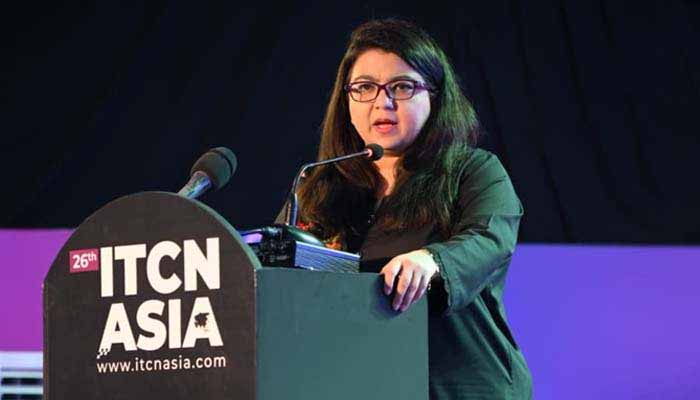
Shaza Fatima, Pakistan’s Federal Minister of Information Technology and Telecommunications, noted that 2025 was a pivotal year in the country’s digital development. This was driven by the enactment of the Digital Nation Pakistan Act 2025 and the establishment of new national digital agencies.
In her year-end remarks, she emphasized governance reforms as a significant milestone. She pointed out that 38 out of 39 federal divisions had fully adopted the e-Office system, reducing document processing from 25 days to just four, which could save approximately Rs9.5 billion annually.
Regarding service delivery, she highlighted the success of Islamabad’s ParkApp, which attracted over 1.37 million users and generated Rs22.86 billion. The National Job Portal also saw over 510,000 resumes uploaded and more than 33,000 federal jobs advertised.
In healthcare, the “One Patient, One ID” initiative at PIMS increased daily outpatient capacity by 3,000 patients and shortened laboratory reporting times by several hours.
She underscored the importance of connectivity and infrastructure projects, mentioning that Pakistan’s telecom subscribers surpassed 200 million, mobile broadband penetration reached 60%, and over 31 million mobile devices were assembled domestically.
During the year, three new submarine internet cables were installed, and a fiber-optic network connecting Karachi to China and Central Asia positioned Pakistan as a regional hub for data transit. The country also improved its standing, climbing 14 spots in the UN E-Government Development Index.
Policy reforms, such as streamlined right-of-way procedures, the finalization of 5G spectrum allocation, and increased rural connectivity initiatives, laid a solid foundation for the next ten years.
Pakistan also introduced its first National AI Policy, launched a national semiconductor program, expanded digital skills training to over 920,000 learners, increased IT exports to $3.8 billion, and made progress in narrowing the gender gap in mobile internet access.
She described 2025 as a year focused on laying the groundwork, with plans for 2026 to prioritize scaling operations and establishing Pakistan as a regional leader in digital innovation.
 ChatGPT
 Perplexity
 Gemini AI
 Grok AI