Select Language:
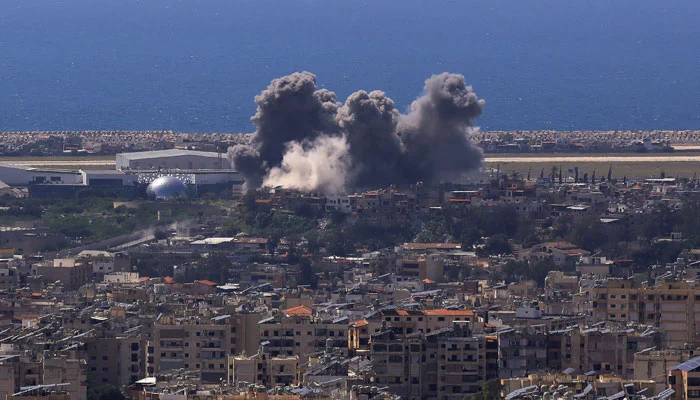
Smoke rises after an Israeli strike on the southern outskirts of Beirut, seen from Baabda, Lebanon, April 8, 2026. — Reuters
Israel has launched its most intense attacks on Lebanon since the recent conflict with Hezbollah began last month, despite Hezbollah temporarily halting its attacks on northern Israel and Israeli forces in Lebanon under a two-week ceasefire brokered by the US and Iran.
Multiple explosions rocked Beirut, with smoke spreading across the city, as Israel’s military claimed it conducted the largest coordinated attack of the ongoing war. Over 100 Hezbollah military and command centers were targeted in Beirut, the Bekaa Valley, and southern Lebanon, according to military officials.
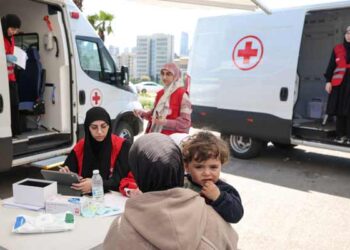
The strikes resulted in 89 fatalities—including a dozen paramedics—and injured 700 people nationwide, according to Lebanon’s health ministry spokesman. In Beirut, witnesses reported seeing motorcyclists rushing to hospitals to assist wounded due to a shortage of ambulances. Firefighters worked to extinguish flames in a parking lot after one strike destroyed more than a dozen cars.
Lebanon’s medical community, led by Elias Chlela, urged doctors from all specialties to go to hospitals available to provide support. One of Beirut’s major hospitals requested donations of all blood types to help with the casualties.
Israeli Prime Minister Benjamin Netanyahu stated overnight that the ceasefire, which paused the six-week-old US-Israeli conflict with Iran, does not include Lebanon. Israeli forces indicated their operations against Hezbollah there would continue, contradicting comments from Prime Minister Shehbaz Sharif, a key mediator in the ceasefire talks, who had said Lebanon was included in the truce.
Earlier, Lebanon’s official news agency, NNA, reported ongoing Israeli strikes throughout southern Lebanon, including artillery shelling and a dawn airstrike near a hospital that killed four people. The Lebanese health ministry confirmed an airstrike on Sidon killed eight and wounded 22. Another strike hit central Beirut early in the evening.
Hezbollah ceased attacks against Israeli targets early Wednesday, according to three Lebanese officials close to the group. The last public statement from Hezbollah on its military activities, made at 1 a.m., claimed it targeted Israeli forces in Lebanon Tuesday evening.
A woman surveyed the site of an Israeli attack in Al Manara, Beirut, where an apartment was hit, causing minor damage to surrounding buildings. The military’s recent strikes, mostly in civilian-populated areas, drew sharp criticism from Lebanon. Prior warnings were issued for some parts of southern Beirut and Lebanon, but central Beirut was hit without a prior alert.
Israeli military spokesperson Avichay Adraee claimed on X (formerly Twitter) that Hezbollah had relocated from its Dahiyeh stronghold in southern Beirut to city areas including the north. He warned Hezbollah that Israel would pursue and act forcefully wherever they are.
Since Hezbollah launched rockets in solidarity with Iran on March 2, over 1,500 people have been killed in Israel’s air and ground campaign in Lebanon, including more than 130 children and over 100 women. Israel has issued evacuation orders covering roughly 15% of Lebanon, mostly in the south and surrounding Beirut’s suburbs, displacing over 1.2 million residents.
Israel has also vowed to control southern Lebanon up to the Litani River as part of a “security zone” meant to safeguard its northern communities. A displaced individual from Beirut’s southern suburbs expressed hope for a ceasefire, lamenting that Lebanon’s economy is collapsing under the strain.
Meanwhile, families in Sidon prepare to return home, stacking belongings onto cars while waiting for official clearance. The local mayor, Mustafa al-Zein, reported that over 28,000 people are sheltering in the area as of Tuesday night and urged residents to wait for official signals before attempting to return.
 ChatGPT
 Perplexity
 Gemini AI
 Grok AI