Select Language:
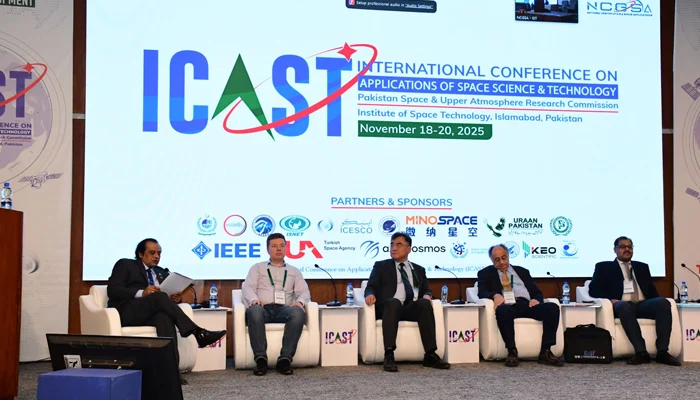
The International Conference on Space Science and Technology Applications (ICAST–2025) wrapped up Thursday at the Institute of Space Technology (IST) in Islamabad, marking a significant milestone for Pakistan’s progress in scientific research and global cooperation in peaceful space exploration.
The conference was organized collaboratively by the Pakistan Space & Upper Atmosphere Research Commission (SUPARCO) and IST. Over three days, it attracted an exceptional assembly of scientists, scholars, students, government officials, astronauts, and representatives from more than 25 nations.
With more than 2,000 attendees, over 70 international delegates, and more than 80 technical and thematic sessions, ICAST–2025 stands out as Pakistan’s largest and most internationally prominent space science event to date. Its theme, “Space for Sustainable Development,” fostered high-level discussions and innovative sharing across a broad spectrum of fields including satellite technology, astronomy, astrophysics, AI-powered geospatial tools, climate adaptation strategies, disaster management, space law, aeronautics, astronautics, and upcoming space missions.
Seminars, workshops, poster exhibitions, a tech showcase, and the Meet the Astronauts Forum—featuring space explorers from Turkey, Mongolia, and the US—created valuable hands-on learning and networking opportunities for participants from various backgrounds.
The closing event saw the presentation of the ICAST report by Conference Secretary Prof. Dr. Najam Abbas, highlighting the event’s achievements, international participation, and collaborative efforts. Chairman of SUPARCO, Muhammad Yousaf Khan, expressed gratitude to all speakers, delegates, and partners, reaffirming Pakistan’s dedication to fostering peaceful international cooperation in space.
IST Vice Chancellor Syed Najeeb Ahmed praised the teamwork involved in organizing the conference, emphasized IST’s commitment to advancing space education and research, and thanked everyone for their contributions to the event’s success.
ICAST–2025 also served as a diplomatic platform, hosting the 14th Governing Body Meeting (GBM) of ISNET and facilitating the signing of several Memoranda of Understanding (MoUs) with international organizations and space agencies. These agreements are set to boost cooperation in Earth observation, space applications, climate monitoring, capacity building, and future exploratory missions.
The event featured a session on Moon Sighting: Scientific, Religious, and Technological Perspectives, along with special activities linked to GIS Day 2025, showcasing Pakistan’s emerging leadership in modern geospatial technology, environmental monitoring, and Earth observation systems.
With its impressive outcomes and global outreach, ICAST–2025 firmly positions Pakistan as a regional hub for space collaboration, innovation, and knowledge exchange. It ends on a proud note for Pakistan, celebrating scientific excellence, international partnerships, and a shared vision of harnessing space for the benefit of all humanity.
Federal Minister for Planning, Development, and Special Initiatives Ahsan Iqbal attended the closing ceremony as the chief guest.
 ChatGPT
 Perplexity
 Gemini AI
 Grok AI