Select Language:
Election participation reached 56%, according to officials. The Taqaddum Party secured 27 seats in the parliamentary vote, while Iraq’s ruling alliance claims to be the largest bloc following the results. The upcoming government faces the complex task of balancing influence from the United States and Iran. It also needs to oversee numerous armed factions that are more accountable to Iran’s leadership than to the Iraqi state, amidst mounting pressure from Washington to disarm these militias.
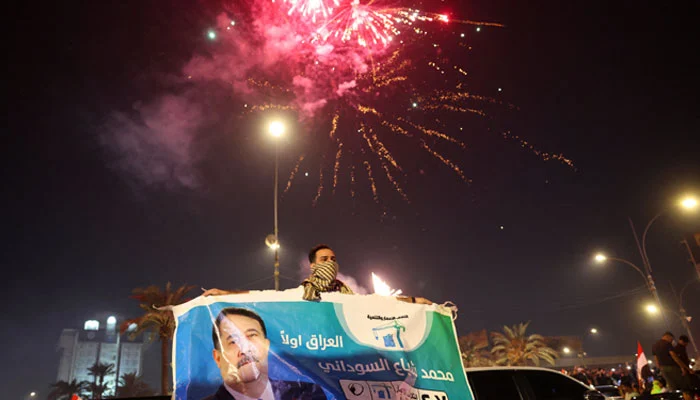
Prime Minister Mohammed Shia al-Sudani’s political coalition emerged with the highest number of seats, totaling 46 out of 329, as reported by the election commission. The Taqaddum Party, predominantly supported by voters in western and northern Iraq, gained 27 seats. Nouri al-Maliki’s State of Law faction secured 29 seats, and the Kurdistan Democratic Party (KDP) earned 26.
The official voter turnout was recorded at 56.11%. Following the announcement, parties aligned with the current government declared themselves the largest parliamentary group and committed to proceeding with the nomination process for a new prime minister.
Sudani had aimed for a second term, but many disillusioned young voters viewed this election as an opportunity for established parties to continue controlling Iraq’s oil revenues. Nevertheless, Sudani has portrayed himself as a leader capable of steering Iraq toward stability, emphasizing efforts to challenge the influence of traditional political factions that helped him ascend to power.
 ChatGPT
 Perplexity
 Gemini AI
 Grok AI