Select Language:
- Khamenei asserts that the Strait of Hormuz will stay closed.
- Claims that Iran will seek compensation from adversaries.
- “We believe in building friendships with our neighbors,” Khamenei states.
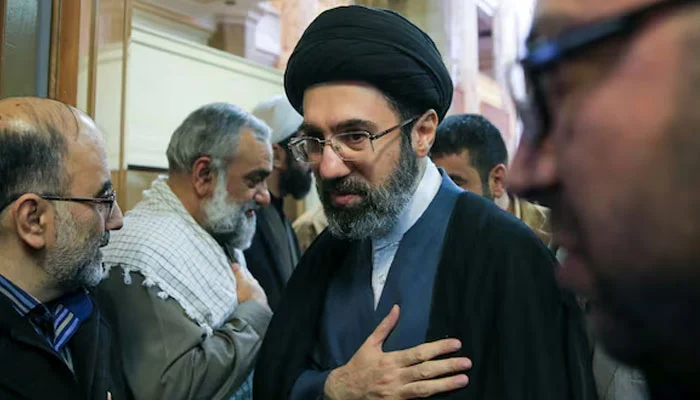
In his first public statement since succeeding his slain father, Iran’s new Supreme Leader Mojtaba Khamenei declared that Iran would retaliate for the blood of its martyrs, keep the Strait of Hormuz closed, and target U.S. military bases. He emphasized that the Strait, vital for global oil flow, remains firmly shut to exert pressure on adversaries.
Khamenei also declared that Iran intends to seek reparation from its enemies or take measures to dismantle their assets. He highlighted that the ‘resistance front’ remains intrinsically linked to the Islamic Revolution’s core values.
“While stressing the importance of good neighborly relations, we only targeted military bases and plan to continue doing so,” stated Iran’s new leader.
Following recent attacks, two oil tankers caught fire in an Iraqi port after suspected Iranian boats used explosives. These escalations disrupted Middle Eastern oil exports and contradicted President Donald Trump’s earlier claims that the conflict was nearing its end. Recent verified images from Basra showed ships engulfed in enormous orange flames, resulting in at least one casualty.
Earlier in the day, three other vessels in the Gulf were attacked. Iran’s Revolutionary Guards claimed responsibility for at least one assault—on a Thai bulk carrier that was set ablaze for disobedience—and another container ship near the UAE was struck by an unknown projectile.
Disruption of Global Energy Supply
The ongoing conflict, initiated with a US-Israeli bombing campaign at the end of February, has resulted in approximately 2,000 casualties and caused what the International Energy Agency describes as the largest disruption to global energy markets in history. Despite claims by the US and Israel that they have damaged Iran’s long-range missile and nuclear capabilities, Iran continues to launch drones into countries like Kuwait, Iraq, the UAE, Bahrain, and Oman.
Lebanon’s Iran-backed Hezbollah launched its most extensive barrage of rockets into Israel during the conflict, prompting Israeli retaliations in Beirut. Oil prices shot back above $100 per barrel after initially dropping earlier this week when Trump suggested the war would conclude soon. Iran insists that oil won’t pass through the Strait of Hormuz—crucial for worldwide energy trade—until US and Israeli attacks halt.
President Trump Declares Victory
President Trump has repeatedly assured markets that the spike in oil prices is temporary. However, he has not provided a clear plan to reopen the Strait or end the conflict. While US and Israeli officials aim to dismantle Iran’s missile and nuclear programs, Trump also demands Iran’s unconditional surrender and influence over its leadership.
“You don’t want to declare victory too early, but we’ve already won,” Trump declared at a rally in Kentucky. “Within the first hour, this was over.”
He claimed the US has nearly destroyed Iran but insisted the job isn’t finished yet, emphasizing the importance of seeing the campaign through to completion.
 ChatGPT
 Perplexity
 Gemini AI
 Grok AI