Select Language:
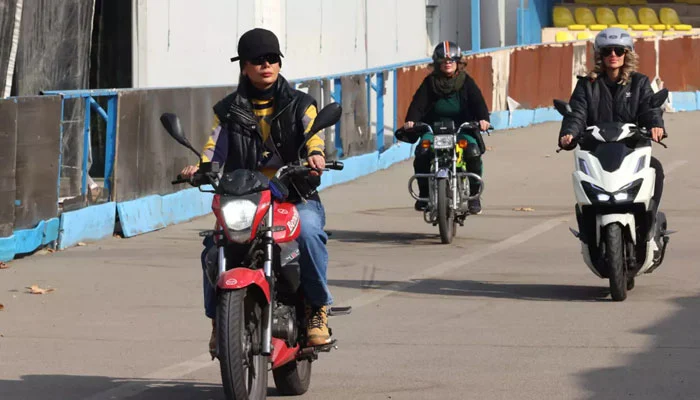
When she first began learning to ride a motorcycle, Iranian Maryam Ghelich would navigate Tehran’s empty streets at night to avoid scrutiny over her clothing or the absence of a license. Now, after 15 years, Ghelich has trained hundreds of women, helping them maneuver not only the city’s congested roads but also overcoming societal barriers faced by women motorcyclists in Iran. Recently, there has been a significant increase in demand for riding lessons.
“This sport has always been a passion of mine, but in Iran, riding motorcycles was long considered a male domain,” Ghelich shared at a training facility in northern Tehran.
Across Iran’s streets and intersections, women on scooters and bikes donning colorful helmets are becoming an increasingly familiar sight, reflecting a subtle but perceptible shift in social attitudes over just a few months.
“I wanted to demonstrate that women can also succeed in this field,” said Ghelich, 49, and a seasoned member of Iran’s Motorcycling and Automobile Federation. She noted how she’s seen these changes unfold firsthand after more than a decade as one of the few women riders in the country.
“People’s views in our society have truly evolved. It wasn’t accepted at all before,” she explained, pointing out a recent surge in women signing up for her classes, whether for city commuting or racing.
Seeing women riding confidently on the streets now gives her great satisfaction, especially knowing that families are increasingly supportive.
### Licensing Challenges
However, obtaining motorcycle licenses for women in Iran remains a major obstacle and a legally ambiguous issue. While traffic laws do not explicitly prohibit women from riding motorcycles, authorities have historically refused to issue licenses to female riders. This gap has become more pressing with the rising number of women on bikes.
Niloufar, a 43-year-old fashion designer who only wanted to be identified by her first name and recently joined Ghelich’s riding course, expressed serious concern over the lack of licensing.
“Even if a woman rides very professionally, without a license, she could be legally blamed if she gets into an accident—regardless of who was at fault,” she said.
Officially, authorities claim women are permitted to ride motorcycles. Government spokesperson Fatemeh Mohajerani stated there’s “no legal ban.”
In September, Iran’s traffic police chief, Teymour Hosseini, reiterated that officers do not have the authority to interpret laws based on personal or religious beliefs. “The police enforce the law as written, and whatever directives are issued, we are required to follow them,” he affirmed.
Some officials view the dress code, in place since shortly after the 1979 revolution, as an additional barrier. It mandates modest clothing and head covering for women, and some conservative voices consider women riding bikes without proper hijab or with inadequate coverage as against Islamic law.
Religious hardliners, including lawmaker Mohammed Seraj, have dismissed women riding motorcycles as inappropriate and incompatible with societal norms.
### Changing Attitudes and Evolving Norms
Ghelich pointed out that clothing restrictions have long been a hurdle for women motorcyclists. She recalled races from years past where women were required to wear long overalls over their leather suits—rules she found quite restrictive. Over time, conditions have eased, and police seem to be less strict, often releasing seized bikes more quickly.
In recent years, Iranian women have increasingly challenged social boundaries, defying the country’s strict rules—including the mandatory hijab. The movement gained momentum following the tragic death in custody of Mahsa Amini in September 2022, after her arrest for not adhering to hijab regulations.
Mona Nasehi, a 33-year-old beauty salon owner who started riding this year, recounted how police once attempted to stop her—possibly because she was riding alone—but she was too frightened to pull over.
“I’d heard that police usually treat women riders kindly, but we still fear they might insult us or confiscate our bikes,” she said.
Nayereh Chitsazian, 53, who bought her motorcycle just last week, said that her license is the missing piece, but her registration and insurance are in order.
“The police have no real reason to object,” she stated. “My bike is registered and insured, so there’s no logical reason for them to stop me.”
 ChatGPT
 Perplexity
 Gemini AI
 Grok AI