Select Language:
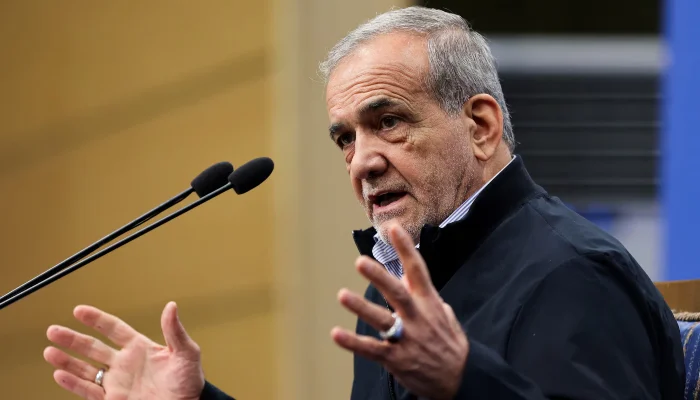
Iran’s President Masoud Pezeshkian attended a press conference in Tehran on September 16, 2024, as reported by Reuters.
Amid ongoing economic turmoil, shopkeepers in Tehran have closed their stores for a second consecutive day, protesting the sharp decline of the rial in the unofficial market. The US dollar has surged to approximately 1.42 million rials from 820,000 rials a year earlier, while the euro nears 1.7 million rials, according to currency tracking sites.
President Pezeshkian urged the government to heed the protesters’ “legitimate demands,” calling for dialogue between officials and representatives of the demonstrators to address the economic crises responsibly, as reported by IRNA. Protesters are demanding immediate government actions to stabilize the exchange rate and implement a clear economic plan, according to ILNA.
The volatile currency prices have hindered sales of imported goods, causing both buyers and sellers to hold off transactions until the economic outlook stabilizes. Protesters expressed frustration, stating that conducting business under current conditions has become impossible.
Images from Fars news agency showed large crowds occupying a major central Tehran thoroughfare, known for its numerous shops, with some photos indicating the use of tear gas to disperse crowds. Minor clashes between protesters and security forces were reported, raising concerns about potential instability.
Iran’s Chief Justice Gholamhossein Mohseni Ejei called for swift punishment of those responsible for currency fluctuations, according to Mizan Agency. The government also announced the appointment of Abdolnasser Hemmati as the new governor of the Central Bank—Hemmati, a former economy and finance minister, was dismissed by parliament in March due to the rial’s depreciation.
Meanwhile, President Pezeshkian submitted the budget for the upcoming Persian year to parliament, vowing to combat inflation and high living costs. Inflation stood at 52% annually as of December, but prices for essentials continued to rise sharply beyond this figure.
Iran’s already strained economy, heavily impacted by decades of Western sanctions, faced further pressure when the United Nations reinstated international restrictions linked to its nuclear program in late September. Western countries and Israel accuse Iran of pursuing nuclear weapons—a charge Tehran denies.
 ChatGPT
 Perplexity
 Gemini AI
 Grok AI