Select Language:
Iran is getting ready to establish a framework for nuclear negotiations within the next few days. Key regional players are passing messages back and forth to facilitate talks. Tehran refuses to accept ultimatums and is pushing for the lifting of sanctions as part of the agreement.
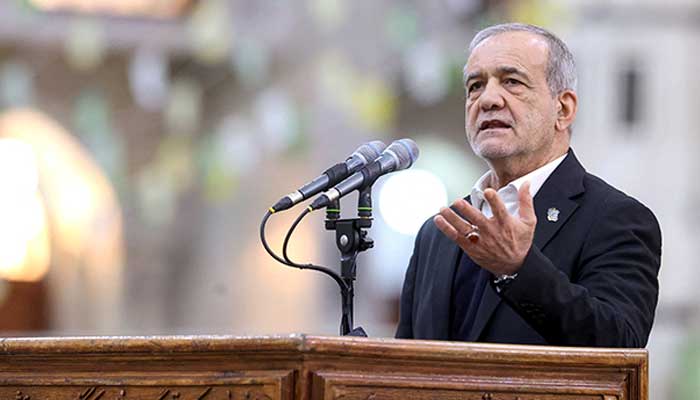
Iranian President Masoud Pezeshkian has instructed officials to begin discussions with the United States, according to local media reports on Monday. This follows U.S. President Donald Trump’s expressed hope for a deal that could help prevent military intervention against Iran.
In response to recent anti-government protests that peaked last month, Trump has threatened military action and sent an aircraft carrier group to the Middle East. Despite escalating pressure on Iran, Trump remains optimistic about reaching a diplomatic solution, and Iran has signaled its willingness to pursue dialogue, asserting it will respond strongly to any aggression.
A government source cited by the news agency Fars confirmed that President Pezeshkian ordered the opening of talks with the U.S. on Iran’s nuclear program, although no specific date has been announced. The same report appeared in Iran’s government newspaper and the reformist daily Shargh.
Iran announced on Monday that it is developing a method and framework for negotiations, which is expected to be finalized shortly, with messages exchanged through regional intermediaries. Foreign Ministry spokesman Esmaeil Baqaei stated, “Several points have been addressed, and we are reviewing and finalizing the details of each stage in the diplomatic process, aiming to conclude in the coming days.” He did not provide further details about the negotiations’ content.
Trump warned that time is running out for Iran to agree on its nuclear program, which Western nations believe is aimed at creating an atomic bomb. Baqaei emphasized that Iran “never accepts ultimatums” and could not confirm whether any messages had been received.
Regional countries are advocating for diplomacy to ease tensions. Iranian Foreign Minister Abbas Araghchi, who recently visited Turkey and communicated with counterparts in Egypt, Saudi Arabia, and Turkey via Telegram, expressed hope for a potential deal. He told CNN, “President Trump said no nuclear weapons, and we fully agree. That’s a very good basis for an agreement.” He added that Iran expects sanctions relief in return, noting, “Let’s not talk about impossible things.”
Baqaei highlighted that the neighboring states’ unified stance toward diplomacy underscores their concern that a U.S. attack could ignite regional conflict. Iranian Supreme Leader Ayatollah Ali Khamenei warned on Sunday that a U.S. strike could trigger a “regional war.”
The Supreme Leader also compared recent protests to an attempted coup. Authorities describe the demonstrations, which began over economic hardship and grew more intense in early January, as “riots” incited by the United States and Israel.
Iran has acknowledged the deaths of nearly 3,117 citizens during the unrest, with government figures indicating most casualties were security personnel or innocent bystanders, blaming “terrorist acts” for the violence. The European Union responded by designating Iran’s Islamic Revolutionary Guard Corps (IRGC) as a terrorist organization, prompting Iran to retaliate by labeling European military units as terrorists.
Baqaei stated that the foreign ministry summoned ambassadors of all EU member states in Tehran over the IRGC designation, with further responses expected. Additionally, Iranian state media reported the arrest of four foreigners involved in the protests, though their nationalities remain unspecified.
Authorities continue to announce arrests, with human rights organizations estimating that at least 40,000 people have been detained in relation to the protests.
 ChatGPT
 Perplexity
 Gemini AI
 Grok AI