Select Language:
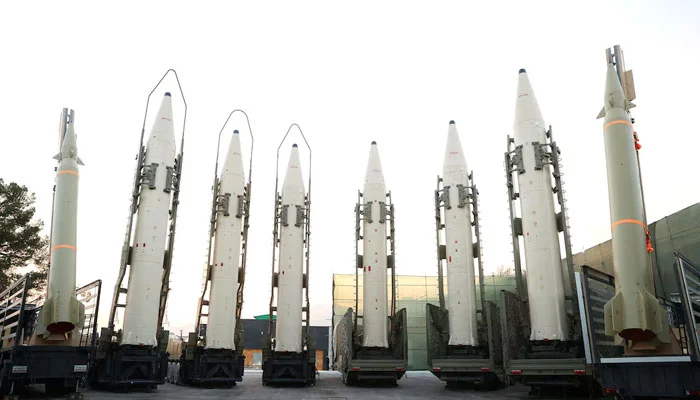
During the 47th anniversary of the Islamic Revolution in Tehran on February 11, 2026, crowds gathered around a missile display. — Reuters
– Iran and the United States are scheduled for additional discussions in Geneva on Tuesday.
– Tehran indicates a flexible stance regarding its nuclear program.
– Iran emphasizes that any agreement should provide economic benefits for both nations.
Iran aims for a nuclear deal with the U.S. that brings tangible economic advantages to both sides, according to a reported Iranian diplomat ahead of the upcoming talks.
Earlier this month, Iran and the U.S. resumed negotiations to resolve their long-standing dispute over Tehran’s nuclear activities and to prevent the possibility of military conflict. The U.S. has sent a second aircraft carrier to the region and is considering a prolonged military effort if diplomatic efforts fail, U.S. officials told Reuters.
At a press conference in Bratislava, U.S. Secretary of State Marco Rubio stated that President Donald Trump prefers diplomacy and negotiation but acknowledged that a successful deal with Iran has not yet been achieved.
“No one has managed to strike a successful deal with Iran, but we’re going to give it a try,” Rubio said.
While Iran has threatened to target U.S. military bases in the Middle East if attacked, the country adopted a more conciliatory tone on Sunday.
Hamid Ghanbari, Iran’s deputy director for economic diplomacy, said, “For an agreement to be sustainable, it must also secure quick and substantial economic benefits for the U.S.,” according to semi-official Fars News Agency.
He added, “Negotiations involve interests in oil and gas fields, joint resource management, mining investments, and aircraft procurement,” criticizing the 2015 nuclear pact for not protecting U.S. economic interests. The 2015 deal, which eased sanctions on Iran in exchange for limits on its nuclear program, was pulled out of by Trump in 2018, who reimposed heavy sanctions.
On Friday, a source told Reuters that U.S. envoys Steve Witkoff and Jared Kushner would meet Iranian officials in Geneva on Tuesday. This was later confirmed by a senior Iranian official.
“Steve Witkoff and Jared Kushner are currently traveling to conduct key meetings. We’ll see how they turn out,” Rubio said, offering no further details.
Unlike the multilateral negotiations leading to the 2015 agreement, current talks are limited to Iran and the United States, with Oman serving as an intermediary.
Iran’s Foreign Minister Abbas Araqchi has traveled to Geneva for indirect negotiations with the U.S., along with meetings with officials from the IAEA and other parties.
Iran shows a willingness to compromise; Deputy Foreign Minister Majid Takht-Ravanchi told the BBC on Sunday that Iran is ready to modify its nuclear activities in exchange for sanctions relief and asserted that “it’s now up to America to demonstrate that they want to make a deal.”
He highlighted Iran’s flexibility, referencing Iran’s atomic chief who recently stated the country would be willing to reduce its highly enriched uranium in exchange for sanctions removal. However, Tehran maintains it will not accept complete uranium enrichment elimination, a major sticking point, as the U.S. sees Iran’s enrichment capacity as a potential route to nuclear weapons. Iran denies seeking such weapons.
In June, the U.S., along with Israel, conducted airstrikes targeting Iranian nuclear sites.
The U.S. is increasing economic pressure on Iran, with reports indicating efforts to reduce Iran’s oil exports to China, as agreed upon during a White House meeting earlier this week, according to Axios.
 ChatGPT
 Perplexity
 Gemini AI
 Grok AI