Select Language:
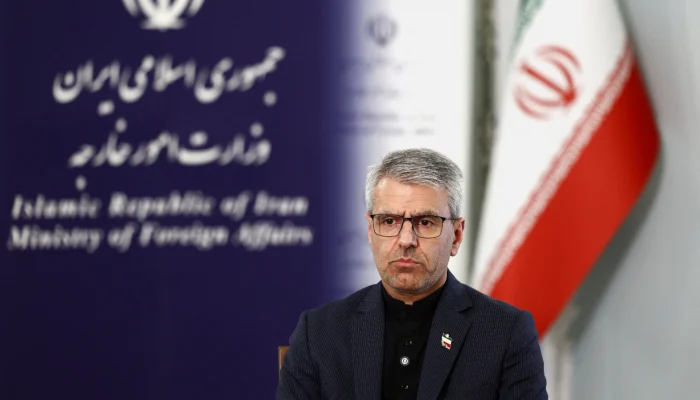
Iran’s Foreign Ministry spokesperson Esmaeil Baghaei participated in an interview amid the ongoing US-Israeli tension with Iran, in Tehran on April 5, 2026. — Reuters
– The discussions represent the highest-level contact since the 1979 revolution.
– The negotiations spanned approximately 21 hours.
– The agenda was further complicated by issues concerning the Strait of Hormuz.
Iran emphasized that diplomatic efforts persist even after the recent talks with the U.S. in Islamabad concluded without an agreement. According to the Tasnim news agency, Iranian Foreign Ministry spokesperson Esmaeil Baqaei stated that Tehran and Washington had reached a mutual understanding on several topics, though there were disagreements on two or three key issues.
This Islamabad meeting marked the most senior engagement between the two nations since the Islamic Revolution. Tensions escalated following an attack by the U.S. and Israel on Iran on February 28, prompting Tehran’s retaliation, which has fueled conflict across the Middle East and disrupted the global economy.
After the marathon 21-hour dialogue, U.S. Vice President JD Vance announced he was departing after presenting Tehran with what he called their “final and best offer.” Meanwhile, Iran’s Parliament Speaker Mohammad Bagher Ghalibaf, who led the negotiations for Iran, mentioned that the U.S. failed to gain Iran’s trust but acknowledged that Washington understood Iran’s reasoning and principles.
Baqaei also commented that the talks were held in an atmosphere of mistrust. “It’s natural that an agreement wasn’t expected to be reached after just one session,” he told Iranian media. He stressed that “diplomacy is an ongoing process,” describing it as a tool to safeguard national interests that diplomats must wield both during wartime and peace.
He noted that the success of negotiations depends on the “seriousness and good faith of the opposing side” and on accepting Iran’s legitimate rights and interests. Additionally, he highlighted the complexity of the issues at hand, mentioning that new concerns, such as the Strait of Hormuz, had been added to the agenda, each with its own challenges.
 ChatGPT
 Perplexity
 Gemini AI
 Grok AI