Select Language:
- Tehran states it will defend itself against US actions.
- Araghchi anticipates renewed Iran-US discussions in Geneva.
- Tehran prepares a draft agreement to prevent conflict.
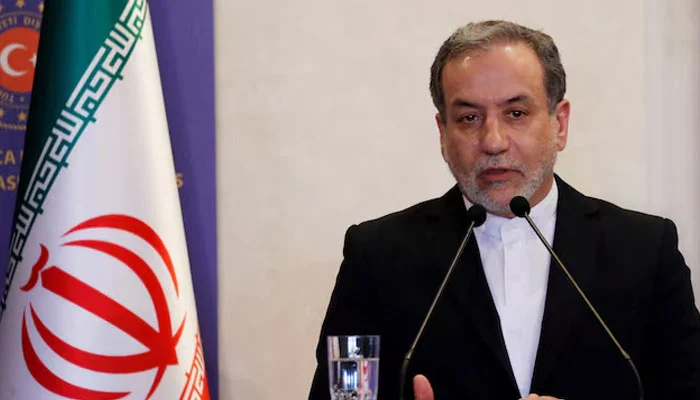
PARIS: Iran’s top diplomat declared Sunday that his country would retaliate against U.S. interests in the Middle East if attacked, yet he maintained there remains hope for a diplomatic solution.
In an interview with CBS, Foreign Minister Abbas Araghchi said new negotiations are likely to take place on Thursday, amid increasing fears of conflict following a significant U.S. military deployment to the region.
The United States has increased its military presence with two aircraft carriers, additional jets, ships, and enhanced regional air defenses, heightening tensions after recent threats of military intervention. This comes amid a crackdown on nationwide protests and rights groups’ reports of thousands of deaths.
“If the U.S. attacks us, we have every right to defend ourselves,” Araghchi stated, referencing U.S. regional interests as potential targets.
Despite this, he expressed optimism, saying, “There’s a good chance for a diplomatic resolution.”
Following recent talks in Geneva, Iran is working on a draft proposal aimed at avoiding military conflict.
“I believe that when we meet again, probably this Thursday in Geneva, we can work through those points, produce a solid text, and reach an agreement quickly,” Araghchi told CBS.
Earlier reports from Axios, citing an unnamed senior US official, indicated that if Iran submits its proposal within 48 hours, Washington is prepared to resume detailed negotiations later this week.
The U.S. has intensified its military readiness in the Middle East, with the deployment of two aircraft carriers and additional armed forces, coupled with strengthened air defenses, as part of its strategic posture.
U.S. Middle East envoy Steve Witkoff, in an interview with Fox News, questioned why Iran has not yet yielded to U.S. pressure.
“The President is wondering why they haven’t… I don’t want to say ‘capitulated,’ but why haven’t they capitulated?” he questioned.
“Given the military presence and naval strength deployed, why haven’t they come to us, saying, ‘We don’t want weapons, and here’s what we’re willing to do?’”
Western nations worry Iran’s nuclear program might be intended for weapon development, a claim Tehran has long denied, asserting its right to enrich uranium for peaceful purposes.
Regarding uranium enrichment, Araghchi stated: “As a sovereign nation, we have the right to decide independently.”
Fears of Conflict
Diplomacy last year was halted following Israel’s bombing campaign against Iran, which triggered a 12-day conflict in June, involving U.S. strikes on nuclear sites.
Despite recent Oman-mediated talks, anxieties about another outbreak of conflict persist among Iranians.
“I don’t sleep well at night, even taking medication,” said Tehran resident Hamid, expressing concern for his family’s well-being.
Mina Ahmadvand, 46, an IT technician, believes war between Iran, the U.S., and Israel is inevitable and has prepared for that possibility.
“I don’t want war, but you can’t ignore what’s happening on the ground,” she explained.
Several countries, including Sweden, Serbia, Poland, and Australia, have advised their citizens to leave Iran, noting that commercial flights remain available but could change rapidly.
 ChatGPT
 Perplexity
 Gemini AI
 Grok AI