
Select Language:
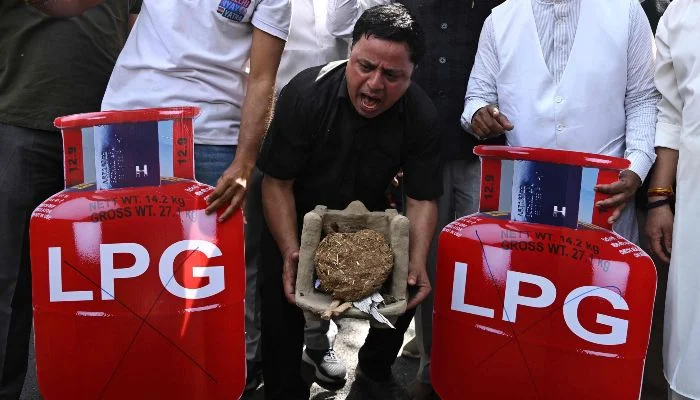
Protesters from India’s opposition Congress party demonstrated in New Delhi on March 13, 2026, protesting against rising fuel prices and shortages of liquefied petroleum gas (LPG).
In the city’s low-income Madanpur Khadar neighborhood, 36-year-old domestic worker Sheela Kumari revealed that she has had to stop using LPG cylinders for cooking after prices more than doubled. “We used to buy cylinders for around 1,800-2,000 rupees ($19-$21), but now on the black market, it’s up to 5,000 rupees ($53),” she said, which is nearly her entire monthly salary of 6,000 rupees ($63). “It’s unbelievable for us,” she added, explaining that their best alternative was reverting to firewood and coal.
Kumari explained that a 14-kilogram cylinder only lasts 15 to 20 days for her family of six, even when carefully managed. She pointed out that a 10-kilogram bundle of firewood, which lasts several days, costs just 30 rupees ($0.30). “It affects our health—my children cough,” she said. “But what else can I do?”
Her neighbor, 45-year-old Munni Bai, who suffers from asthma, has switched temporarily to using an electric stove and biogas made from cow dung to breathe easier. However, she says she’s now compelled to rely on other fuels because gas has become prohibitively expensive. “Gas costs too much,” she noted. “We can’t depend on it—so we shifted from coal and wood due to health issues, but it’s hard to stay sustainable now.”
Activists emphasize that access, rather than just shortages, is at the root of the problem. Many migrant workers lack the documentation required for subsidized LPG and turn to informal markets, where hoarding has driven prices up two to three times. “There isn’t a major shortage yet, but hoarding is increasing,” said Deepak, a representative from the Centre for Advocacy and Research (CFAR). “Many rely on black-market cylinders, and prices are soaring.”
New Delhi and its sprawling metropolitan area of 30 million are routinely ranked among the world’s most polluted capitals. Emissions from power plants, vehicles, and the burning of garbage and crops combine to create deadly air quality.
For decades, India has promoted the “Ujjwala” initiative to provide over 100 million poor households with access to LPG, aiming to replace indoor use of wood, coal, and biomass, which exposes families to dangerous smoke and toxic particles. Women and children, who spend the most time near cooking fires, are especially vulnerable to respiratory illnesses caused by indoor air pollution.
 ChatGPT
 Perplexity
 Gemini AI
 Grok AI