Select Language:
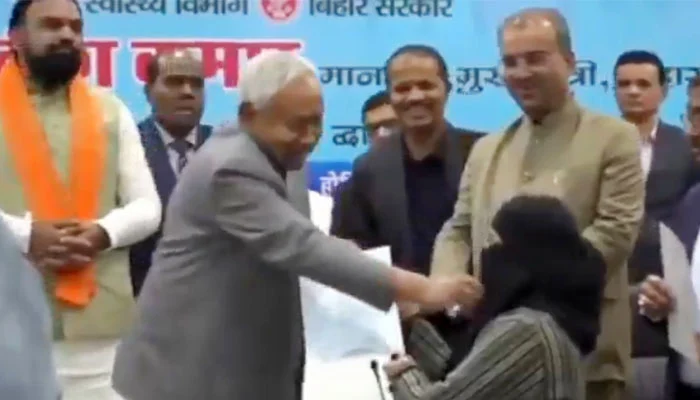
A recent incident in India highlights ongoing tensions around religious inclusivity. During an official event in Bihar, Chief Minister Nitish Kumar was photographed removing the hijab of a newly hired Muslim doctor. The event took place at CM’s secretariat, where appointment letters were being distributed to new doctors. When the woman approached to receive her letter, Kumar, 75 years old, looked at her and questioned, “What is this?” before pulling down her hijab. An official nearby quickly pulled her aside in response.
This act sparked a wave of outrage among minority communities nationwide and drew fierce criticism from political opposition, notably the Congress and Rashtriya Janata Dal (RJD). The Congress publicly condemned Kumar’s behavior, labeling it as “vile” and shaming his conduct as inappropriate towards a female professional. The RJD questioned Kumar’s mental health, suggesting his actions reflected a disturbing mental state.
India has seen a troubling rise in hate crimes against religious minorities, especially during Prime Minister Narendra Modi’s tenure. A recent U.S. report recommended classifying India as a “country of concern” due to rising religious prejudice and violations of religious freedoms. The report pointed out systemic discrimination driven by the RSS and BJP’s Hindutva ideology, emphasizing that these extremist policies promote Hindu nationalism. Historically, the RSS has been involved in violent acts targeting minorities, including Muslims and Sikhs, over several decades.
 ChatGPT
 Perplexity
 Gemini AI
 Grok AI