
Select Language:
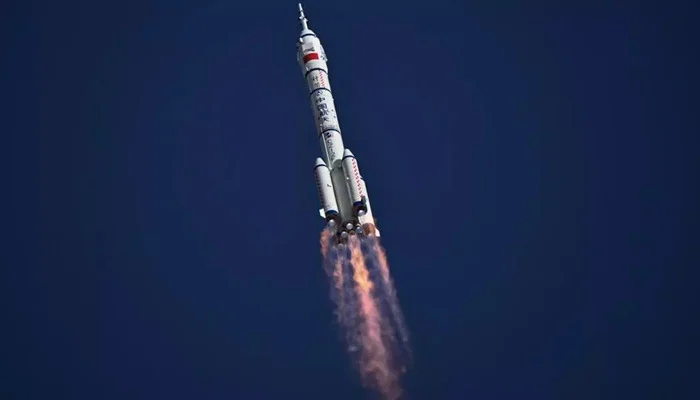
China aims to land astronauts on the Moon by 2030, having already sent numerous robotic missions and retrieved lunar samples. A crewed lunar mission requires new systems currently under development. In 2026, China plans to test its Mengzhou (“Dream Ship”) spacecraft, which will replace the aging Shenzhou and carry astronauts into lunar orbit. Simultaneously, engineers are working on the Long March-10, a nearly 300-foot-long rocket essential for lunar missions, with its first low-altitude test flight completed in February. The lunar lander, called Lanyue (“Seize the Moon”), is expected to make its first flight between 2028 and 2029, ferrying astronauts from orbit to the lunar surface.
China envisions establishing a basic crewed scientific base near the Moon’s south pole by 2035, leveraging water ice believed to exist there. The project is a joint effort with Russia. The base will potentially be constructed with on-site lunar soil bricks using 3D printing technology, which has been tested on Earth and China’s space station, Tiangong. This technique is planned for trial during the uncrewed Chang’e-8 lunar mission around 2028. The overarching goal is for strategic technological breakthroughs, lunar resource utilization, and conducting archaeological research into the Moon’s origins. A more developed lunar base is envisioned around 2040, supported by a satellite constellation on the far side of the Moon to maintain communication.
While China does not frame its lunar ambitions as a competition with the U.S., some analysts acknowledge that establishing a lunar presence challenges U.S. capabilities. Currently, U.S. spacecraft such as Dragon and Orion are more advanced than China’s Shenzhou, but expectations suggest that by 2030, with the new lunar spaceship and landing vehicle, China could catch up in human lunar exploration.
Looking beyond the Moon, China plans to utilize its lunar base starting after 2040 to test technologies needed for a manned mission to Mars. Although some Chinese space scientists have mentioned Mars as a future target, official timelines suggest that the focus will remain on completing lunar landing and establishing an initial lunar base before seriously planning for Mars exploration.
 ChatGPT
 Perplexity
 Gemini AI
 Grok AI