Select Language:
After a week of violence, people living along the Afghanistan-Pakistan border are hopeful that a new ceasefire agreement will put an end to the fighting and restore vital cross-border trade.
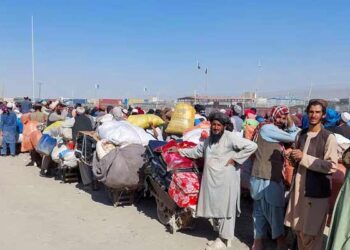
Although border crossings are still shut, daily life is starting to look more normal. Bakers are kneading bread, vendors are rolling out carts filled with produce, and stores are seeing more customers.
“Now people can breathe easier and feel a bit of relief. But just a while ago, gunfire damaged a few houses in our village,” explained Sadiq Shah, a 56-year-old shopkeeper from Baizai on the Pakistani side.
Conflict erupted between Afghanistan and Pakistan after explosions struck Kabul on October 9. The Taliban authorities accused Pakistan of involvement and responded with border attacks, prompting Islamabad to promise a strong counter-response.
Following further clashes that resulted in casualties among soldiers and civilians, the two nations agreed to an initial 48-hour ceasefire on Wednesday. Pakistani military strikes on Afghanistan continued on Friday, with Pakistan saying they targeted militant groups the Taliban shelters and allows to launch attacks into Pakistan.
A second ceasefire was announced on Sunday, bringing relief to villages and traders along the border.
“It’s remarkable—both countries are Muslim and ethnically Pashtun. Why are we fighting?” remarked Shah. “Trade used to pass through here with Afghanistan, but now we’re shooting at each other. What kind of country is that?”
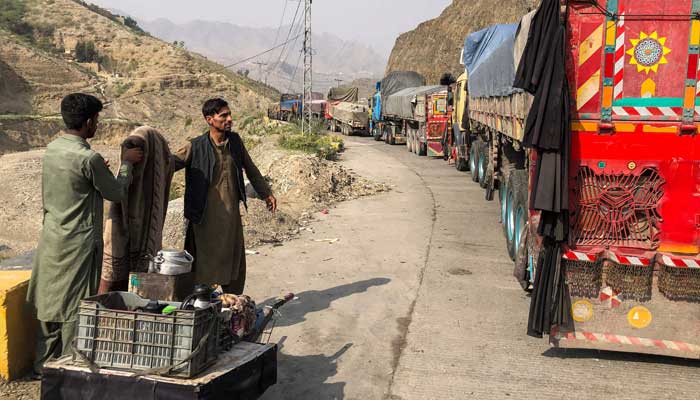
The border was only temporarily reopened this week to allow Afghan refugees sent back by Pakistan under a 2023 deportation campaign. In Torkham, a usually busy crossing point into Afghanistan’s Nangarhar province, stranded drivers were seen buying tea from a vendor as they waited beside colorful trucks.
More than 1,500 trucks, trailers, and containers filled with cement, medicine, rice, and other essentials are halted in Torkham, according to a senior Pakistani customs official in nearby Peshawar. Abdul Rahman Habib, spokesperson for Afghanistan’s Taliban-controlled economy ministry, said fruits and vegetables are rotting while waiting to be exported to Pakistan.
“Businesspeople are losing money,” Habib stated, without estimating the total losses. He warned that if this stalemate persists, prices could rise, unemployment may grow, and markets could become unstable. He emphasized that “trade relations should be kept separate from political issues,” as reported by AFP.
After recent peace talks in Doha, Qatar’s foreign ministry indicated that the ceasefire agreement includes mechanisms to build lasting peace, though specifics have not been shared.
In Spin Boldak, an Afghan border town battered by recent clashes, 39-year-old car salesman Niaz Mohammed Akhund said residents are glad about the truce. “People here rely on cross-border trade—they have no farmland or other income sources,” he said.
Similarly, 24-year-old vendor Nematullah hopes “this problem won’t happen again.” On the Pakistani side, a market worker named Imran Khan urged both nations to develop a “mechanism to end these conflicts and start treating each other like brothers.”
 ChatGPT
 Perplexity
 Gemini AI
 Grok AI