
Select Language:
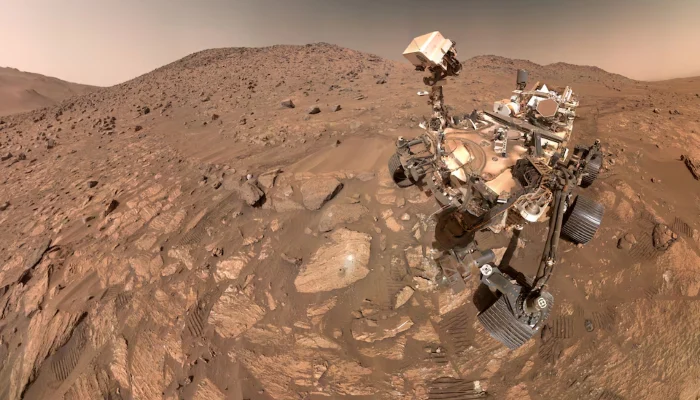
A “selfie” captured by NASA’s Perseverance Mars rover, created from 62 individual images taken on July 23, was released on September 10, 2025. — Reuters
– The crew includes three Americans and one Canadian.
– This is the first time a woman, a person of color, and a non-American are participating in a lunar mission.
– The mission echoes Apollo 8’s historic 1968 lunar flyby.
More than 50 years after the final crewed mission to the Moon during the Apollo program, a team of three men and one woman is preparing for a lunar expedition that could mark a new chapter in U.S. space exploration. The mission, called Artemis II, is scheduled to launch from Florida as early as April 1. Instead of landing, the crew will perform a lunar flyby, similar to Apollo 8’s 1968 mission.
NASA astronauts Reid Wiseman, Victor Glover, Christina Koch, along with Canadian Jeremy Hansen, will undertake this approximately 10-day trip. This journey will feature a series of historic firsts: it’s the first lunar mission involving a woman, a person of color, and a citizen of another country. It also marks the first crewed flight of NASA’s new heavy-lift rocket, known as the Space Launch System (SLS). This massive orange-and-white rocket is designed to enable the U.S. to repeatedly revisit the Moon, with plans to establish a sustained lunar presence as a stepping stone for future exploration.
“We’re returning to the Moon because it’s the next step in our journey to Mars,” Wiseman said during a NASA podcast.
The Artemis program, named after Apollo’s twin sister goddess, aims to develop the technologies needed to eventually send humans to Mars—a much more distant goal. This push comes with the added pressure to beat China, which aims to land astronauts on the Moon by 2030, focusing on the lunar South Pole for its potential natural resources.
While reminiscent of the Cold War-era Space Race between the U.S. and Soviet Union, Harvard professor Matthew Hersch notes that China is “not really competing with anyone but themselves” now. NASA’s investment in lunar programs is significantly lower than during the 1960s, but technological advancements mean today’s craft are far more sophisticated. For example, the onboard computers for Artemis II would be nearly unimaginable to Apollo 8’s crew, which flew to the Moon with electronics comparable to a high-end toaster oven.
However, NASA acknowledges the risks involved. The crew will travel in a spacecraft that has never carried humans to the Moon and is over 238,855 miles away from Earth—about 1,000 times farther than the International Space Station. Peggy Whitson, a former NASA chief astronaut, emphasized the importance of striving for perfection, noting that “if we accept anything less, we increase the risk of failure,” as history has shown that accidents can be fatal.
Before heading to the Moon, the crew will conduct numerous checks and maneuvers while still near Earth. If all goes according to plan, the mission will set the stage for a lunar surface landing by 2028, during the final year of President Trump’s administration. This ambitious timeline relies heavily on private companies developing the lunar lander necessary for surface exploration, which is still under development by Elon Musk’s and Jeff Bezos’s companies.
Despite delays and ballooning costs, NASA hopes Artemis II can revive the sense of national unity and hope reminiscent of Apollo 8’s famous Christmas Eve flyby in 1968. An estimated one billion people worldwide watched that historic mission unfold, which included astronauts Frank Borman, Jim Lovell, and Bill Anders, who captured the iconic “Earthrise” photograph. Today, amidst a deeply divided and uncertain nation, the Artemis II crew’s upcoming journey offers an opportunity to inspire a new generation.
 ChatGPT
 Perplexity
 Gemini AI
 Grok AI