Select Language:
China now makes up nearly 25% of the world’s 58 nuclear fusion companies, solidifying its position as a key player in the international race for fusion energy. Hefei, the capital of eastern Anhui Province, is emerging as one of the country’s main hubs for this industry.
“Hefei is leading in China in terms of the scope and sophistication of its nuclear fusion industrial development,” said a market analyst. “We’ve visited Hefei almost monthly over the past two years to observe the industry, and each visit reveals new advancements.”
An expert at the recent Fusion Energy Technology and Industry Conference 2026 stated that China’s progress in nuclear fusion has rapidly accelerated, moving from basic research to practical engineering and industrial application. The integration of artificial intelligence is expected to further accelerate advancements at a faster-than-anticipated pace.
At the conference, Hefei showcased its top ten innovative achievements for 2025, including breakthroughs in fusion devices, manufacturing of core components, and materials research.
Device Cluster
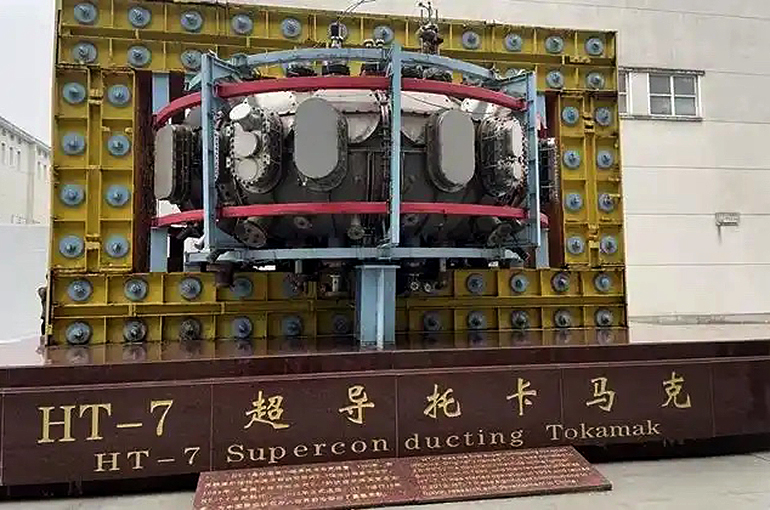
Hefei is home to a group of fusion devices known as the “EAST-BEST-CRAFT” cluster.
The EAST device, or Experimental Advanced Superconducting Tokamak, specializes in maintaining long-duration, stable operations of high-temperature plasma, providing vital physics data for fusion reactor development. The BEST, or Burning plasma Experimental Superconducting Tokamak, focuses on testing compact reactor concepts and exploring pathways toward commercialization. CRAFT, or the Comprehensive Research Facility for Fusion Technology, aims at developing critical systems for fusion reactors.
“Each of these three devices serves a specific purpose and complements the others, creating a comprehensive system from fundamental research to engineering validation,” explained Liu Lu, general manager of a local science and technology innovation group. This cluster forms the core of Hefei’s competitive edge in fusion technology.
Technical Breakthroughs
In January 2025, EAST became the world’s first fully superconducting tokamak to sustain stable plasma at 100 million degrees Celsius for over 1,000 seconds, setting a new world record. Achieving such extended operation durations is crucial because the longer the plasma remains confined, the closer we get to realizing stable fusion reactions. This milestone demonstrated the practical feasibility of achieving sustained high-confinement plasma, a key step toward building operational fusion reactors.
Later that year, in September, the first major component of the compact fusion device BEST, the Dewar base, was successfully installed, indicating speedy progress in manufacturing and assembly. Also, the ion cyclotron heating system for CRAFT, delivering two megawatts of steady power, passed acceptance testing—marking significant progress in producing core components domestically and reducing reliance on external suppliers.
Fusion Ecosystem
Major breakthroughs in scientific equipment continue to attract companies across the entire industry chain. The Anhui Province Fusion Industry Federation, formed last year, now includes over 200 organizations working in sectors such as divertors, magnet systems, and vacuum technology. Hefei’s fusion industry ecosystem is quickly taking shape.
Funding for upgrades to facilities like EAST, as well as projects for BEST and CRAFT, is expected to approach nearly $1.4 billion this year, with government-backed funds leading the investments as patient capital. Hefei Industry Investment Holding has launched phase one of the Hefei Future Fusion Energy Venture Capital Fund, with an initial investment of $143 million and a 15-year lifespan.
According to regional strategic plans released in 2023, Anhui aims to demonstrate fusion power generation using the BEST technology between 2022 and 2027. By 2030, the province intends to develop the China Fusion Engineering Demonstration Reactor, and after 2040, commercial companies will work with industry partners to build higher-capacity fusion reactors and achieve low-cost electricity production.
Market analysts estimate that investments in commercial fusion projects like BEST have already reached around $28.7 billion. As development of commercial reactors gains momentum, the potential for controlled nuclear fusion in the energy market is expected to grow substantially.
 ChatGPT
 Perplexity
 Gemini AI
 Grok AI