Select Language:
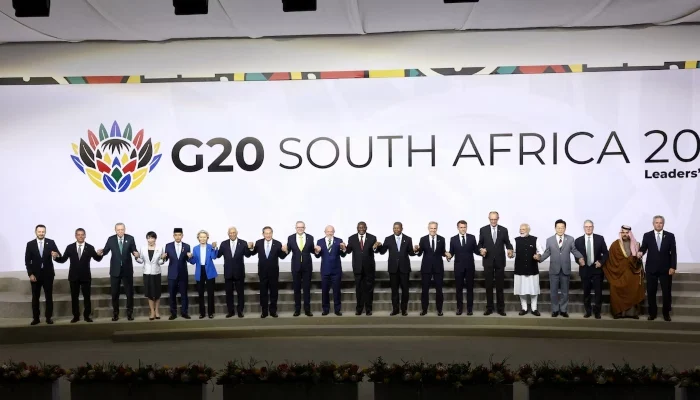
On Saturday, G20 leaders approved a joint declaration to tackle climate change and other global issues, despite opposition from the U.S. The White House accused South Africa of manipulating its leadership role to push a biased agenda. The declaration, drafted without U.S. input, is considered final and cannot be renegotiated, according to South Africa’s spokesperson, reflecting disagreements between Pretoria and the Trump administration, which chose to boycott the summit.
Vincent Magwenya, a spokesperson for President Cyril Ramaphosa, explained, “We worked on this throughout the year, and the last week has been quite intense.” Later, the White House responded, claiming Ramaphosa was “resisting a smooth G20 transition” after initially planning to transfer the presidency to “an empty chair.” Anna Kelly, White House spokeswoman, stated, “South Africa has weaponized its G20 presidency to undermine the group’s founding principles.” The U.S. is set to resume its leadership role next year.
Ramaphosa had earlier declared there was “overwhelming consensus” for the summit’s final statement. However, Argentina, whose far-right President Javier Milei is an ally of Trump, withdrew from negotiations just before the draft was adopted. Argentine officials explained that their concerns were about how the document addressed geopolitical conflicts, especially the Middle East, describing the reference as insufficiently nuanced. Argentina remains committed to G20 cooperation despite not endorsing the final declaration.
Drafting the final G20 leaders’ statement on Friday, without U.S. participation, the envoys emphasized climate change, renewable energy, debt burdens of poor countries, and global cooperation. The language in the declaration on climate issues, which underscores the importance of addressing global warming and adapting to its impacts, was a pointed snub to the U.S., particularly since Trump questions the scientific consensus on climate change.
Opening the summit, Ramaphosa highlighted Africa’s role, saying, “We should not allow anything to diminish the value and impact of South Africa’s first G20 presidency.” His tone contrasted sharply with his White House visit in May, where Trump repeatedly made false claims about South Africa’s farm killings, ignoring Ramaphosa’s corrections. Trump announced that the U.S. would not send delegates to the summit, citing discredited allegations of government persecution of white farmers.
The summit coincides with ongoing global tensions, notably over Russia’s invasion of Ukraine and climate negotiations at COP30 in Brazil. Maki Kobayashi, a Japanese government spokesperson, noted that while diversity among G20 members can pose challenges, it underscores the need for consensus. Meanwhile, Magwenya confirmed that Argentina’s absence from final deliberations didn’t derail the process, emphasizing that there was “sufficient consensus.”
Further disagreements surfaced over U.S. proposals for the G20 agenda, which South Africa and other member states rejected, emphasizing equal partnership and decision-making. European Commission President Ursula von der Leyen warned of “the weaponization of dependencies,” likely alluding to China’s restrictions on rare earths crucial for energy and tech sectors. China’s Premier Li Qiang urged unity, stressing that differences and shortcomings in cooperation are obstacles to global progress.
South Africa refused a U.S. request to transfer the G20 presidency to a junior diplomat, citing protocol breaches. Instead, the Foreign Minister, Ronald Lamola, announced that a diplomat of equal rank would perform the handover, reaffirming South Africa’s stance on the importance of proper diplomatic procedures.
 ChatGPT
 Perplexity
 Gemini AI
 Grok AI