Select Language:
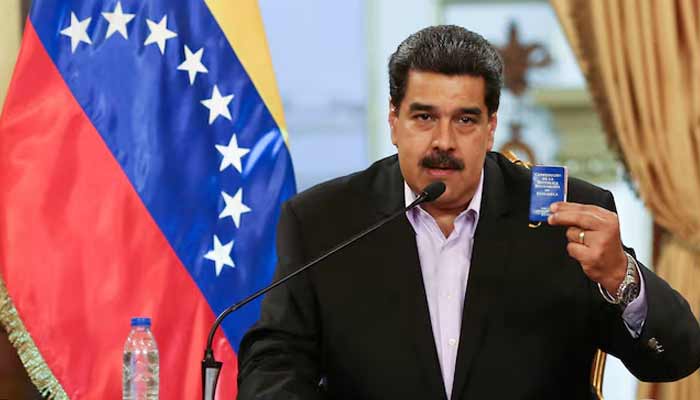
Venezuela’s President Nicolas Maduro, after being captured by U.S. special forces following over a decade in office, maintains a reputation for ruling with strict authority while attempting to present himself as a modest leader devoted to the people.
For months, amid accusations from President Donald Trump accusing him of drug trafficking, the 63-year-old former bus driver deflected mounting pressure by performing dance routines to techno music at nearly daily rallies, which were broadcast live. He often chanted “No war, yes peace!”—in English.
However, many Venezuelans see Maduro as far from a peaceful leader. During his tenure, approximately seven million compatriots fled the country amid reports of arbitrary arrests, unfair trials, torture, and censorship.
Venezuela’s economy has crumbled, experiencing four straight years of hyperinflation and a 80% decline in GDP over ten years. As Maduro consolidated power, he increasingly relied on support from a small group of international allies— notably China, Cuba, and Russia— along with the military, security, and paramilitary forces.
In the protests that erupted after his disputed July 2024 election victory, over 2,400 individuals were detained, 28 people were killed, and around 200 injured amid a brutal crackdown. This violence echoed previous deadly suppression efforts carried out in 2014, 2017, and 2019.
Maduro, tall with a full mustache and graying slicked-back hair, first rose to power in 2013, claiming reelection in 2018 and 2024 in elections widely called fraudulent. In January 2025, he was sworn in for a third term, extending his rule to nearly 18 years— surpassing the 14 years of his revolutionary hero, Hugo Chavez.
Prior to his presidency, Maduro served as a lawmaker, foreign minister, and vice president. Chavez chosen him as his successor shortly before his death in 2013, though Maduro lacked Chavez’s charisma and rhetorical skills. His initial election victory in 2013 was narrow, but he managed to survive multiple crises, including U.S. sanctions and plummeting oil prices that undermined Venezuela’s main economic resource.
Internationally, much of the world recognized opposition leader Juan Guaido as interim president in 2018, but that parallel government quickly collapsed. After the July 2024 elections, the U.S., European countries, and several Latin American neighbors declared opposition figure Edmundo Gonzalez Urrutia as the legitimate leader.
Maduro’s personal life is closely linked to his wife, Cilia Flores, a former prosecutor seven years his senior. He calls her “First Combatant” and “Cilita.” Flores was a lawmaker and the president of the National Assembly from 2006 to 2010, wielding significant behind-the-scenes influence. Trump announced that Flores was captured by U.S. special forces with her husband and was being transported to New York to face federal charges following an early-morning raid in Caracas.
In Caracas, Maduro’s face is visible everywhere. He has worked to craft an image as an authentic man of the people— a baseball fan and salsa lover, often showcasing his dance moves on state TV alongside his wife.
Born in Caracas, Maduro claims both a Marxist and Christian identity. During his teenage years, he played guitar in a rock band. It is believed he intentionally misstates English words to avoid seeming too intellectual.
Throughout his presidency, Maduro faced numerous threats— real and perceived—including a failed drone attack in 2018 that injured soldiers. To divert blame for Venezuela’s struggles, he continued Chavez’s anti-U.S. conspiracy theories, accusing Washington of plotting to oust him.
While positioning himself as a victim of international plots, Maduro suppressed political opposition, imprisoning dissidents and challengers with little regard for legal procedures. His government is under investigation for human rights violations by the International Criminal Court.
Maduro has demonstrated skillful political maneuvering, securing easing of some U.S. sanctions and other concessions by agreeing with opposition groups to hold democratic elections in 2024— though he later broke those agreements, resulting in some sanctions being reinstated.
He has been a constant presence in Venezuelans’ daily lives, often seen on TV raising his fist and speaking anti-imperialist rhetoric. Maduro also appeared in media as the comic character Super-Bigote (Super-Mustache), a hero fighting imperialism.
 ChatGPT
 Perplexity
 Gemini AI
 Grok AI