Select Language:
France plans to enlarge its nuclear arsenal and may permit European allies to host aircraft for nuclear deterrence missions, according to President Emmanuel Macron on Monday. This marks a significant shift in France’s defense policy and signals a major change for Europe.
Historically, most European nations have relied on the United States for nuclear deterrence, with France and the UK being primary nuclear powers. However, recent geopolitical tensions, including Trump’s warming relations with Russia over Ukraine and his more aggressive stance toward traditional allies, have unsettled European governments. Several countries are now exploring how Paris could extend its nuclear protection.
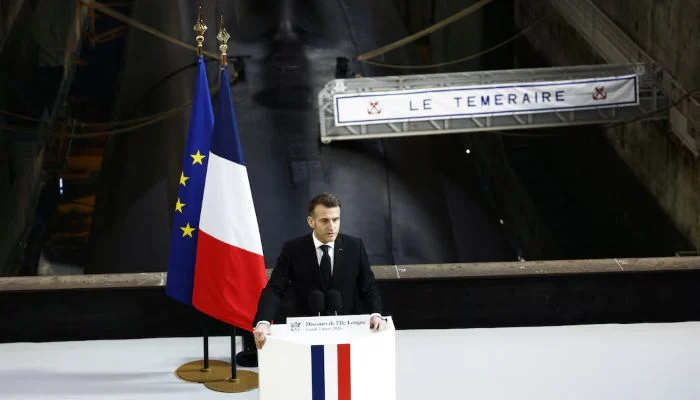
“Europe is facing a period of significant geopolitical instability,” Macron stated during a speech at a submarine base in Brittany. He emphasized the need to strengthen France’s deterrence capabilities. Macron also announced that France’s nuclear doctrine would be updated, with increased cooperation with European partners interested in participating.
Countries such as Germany, Greece, Poland, the Netherlands, Belgium, Denmark, and Sweden could join French nuclear wargames, Macron indicated, expressing confidence that these partners are ready for deeper involvement.
However, Macron did not specify how France would finance this escalation and underscored that the ultimate decision on nuclear strikes would stay exclusively with the French president.
In addition, German Chancellor Friedrich Merz and Macron announced the creation of a nuclear steering group between France and Germany to discuss deterrence strategies, with concrete cooperation beginning within the year. This cooperation would include German forces participating in French nuclear exercises, joint visits to strategic sites, and development of non-nuclear capabilities alongside France and other European partners.
Poland’s Prime Minister Donald Tusk mentioned on X (formerly Twitter) that Poland is engaging in discussions with France and other close European allies on advanced nuclear deterrence programs, emphasizing unity: “We’re arming ourselves with friends so that enemies will think twice before attacking.”
Macron also suggested that, under certain unspecified circumstances, strategic assets could be stationed in other European countries as part of a new “forward deterrence” approach. He indicated that Europe’s strategic air forces might be deployed deep within the continent, though he did not provide specifics.
While France’s nuclear arsenal will increase, Macron stressed the strategy would still be based on “strict sufficiency.” Currently, France spends around €5.6 billion annually to maintain its 290 nuclear warheads, which rank as the world’s fourth-largest arsenal. Britain maintains 225 warheads, while Russia and the US each possess over 5,000.
Macron reaffirmed France’s ongoing nuclear partnership with Britain, stating that the current policy revision has been conducted transparently with the United States and remains aligned with NATO’s nuclear commitments.
 ChatGPT
 Perplexity
 Gemini AI
 Grok AI