Select Language:
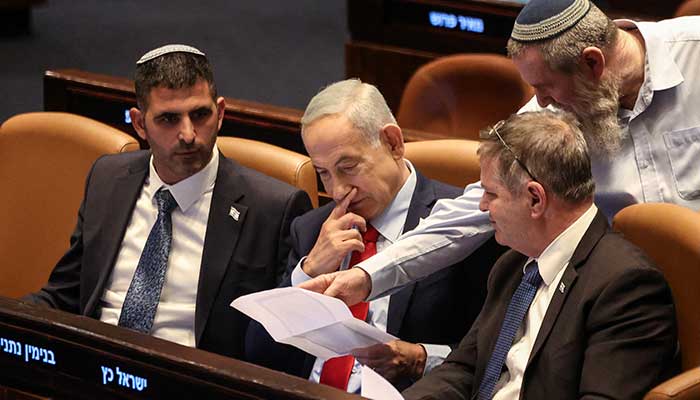
As elections draw near in Israel, President Benjamin Netanyahu sees the ongoing conflict with Iran as a chance to repair his image, which was heavily damaged by the October 7, 2023, Gaza attack, analysts say.
However, the extent of any political gain will rely on how the conflict develops and its duration, they add.
Following Iran’s supreme leader, Ayatollah Ali Khamenei’s, martyrdom during a series of US-Israeli airstrikes, Netanyahu asserted that his strong relationship with the US has allowed Israel to accomplish a goal he has pursued for four decades: decisively targeting the terrorist regime.
The Gaza conflict has hurt Netanyahu’s standing with voters. Critics accuse him of trying to sidestep accountability for the government’s failure on the deadliest day in Israeli history.
At 76, Netanyahu, who leads the right-wing Likud party, is Israel’s longest-serving prime minister, with over 18 years in office spread across multiple terms.
He’s known for his political stamina but has been governing without a parliamentary majority since this summer due to disputes with ultra-Orthodox religious allies.
Additionally, he is on trial for longstanding corruption charges and has sought a presidential pardon, with former President Donald Trump often urging President Isaac Herzog to grant one.
“Total Victory”
Elections are required to be conducted by October 27 at the latest.
Political analyst Emmanuel Navon of Tel Aviv University predicts Netanyahu will call early elections.
“It’s clear he won’t wait until October, especially with the anniversary of October 7 approaching,” Navon stated.
“Although Netanyahu’s popularity plummeted after the Gaza attack, he has been gradually regaining ground,” he continued.
Polls currently favor a Likud victory led by Netanyahu, which would likely result in him being tasked with forming the next government. Nonetheless, he still would not have enough seats to command a majority with his current coalition.
A successful campaign against Iran could alter that scenario, experts suggest.
“This operation clearly bolsters the image Netanyahu wants to project—the idea of a ‘total victory,’” explained independent geopolitical analyst Michael Horowitz to AFP.
“Netanyahu aims to demonstrate that this isn’t just a campaign slogan but a reality; it’s part of his national agenda and electoral strategy,” he added.
“Iran Remains Iran”
Journalist Raviv Druker from Channel 13 remarked that Netanyahu might try to convince the public that victory is complete, even if it’s an illusion, noting that Hamas still controls Gaza and Iran remains a threat even after Saturday’s strikes.
On the popular news site Walla, reporter Ouriel Deskal suggested that Netanyahu might have timed the hostilities to delay the March 30 deadline for passing a budget—one he has struggled to pass due to a fragile majority—by invoking a state of emergency.
Without a budget, the government would collapse on April 1, triggering new elections.
In this context, Netanyahu could enter the election campaign in a weakened position.
Conversely, Navon said, “If this war against Iran proves successful for Israel, it would be a political victory for Netanyahu.”
Yet, if the conflict prolongs, the political landscape could shift dramatically, Horowitz warned.
“Public support for a prolonged war with significant casualties and rising living costs is very low,” he explained.
During last June’s conflict, Iranian missiles killed 30 Israelis. Since Saturday, Iran has retaliated with strikes that have resulted in 10 deaths.
Horowitz pointed out that Israel’s victories are largely credited to its military and civil resilience, enabling it to sustain its longest conflict in history.
“While military approval is increasing, Netanyahu’s popularity isn’t necessarily rising accordingly,” he added.
 ChatGPT
 Perplexity
 Gemini AI
 Grok AI