Select Language:
The European Union has agreed to accelerate efforts to persuade U.S. President Donald Trump to drop tariffs on European countries and is also preparing countermeasures if necessary. EU diplomats revealed that they reached a general consensus on Sunday to bolster diplomatic talks and readiness for retaliation in case the tariffs move forward.
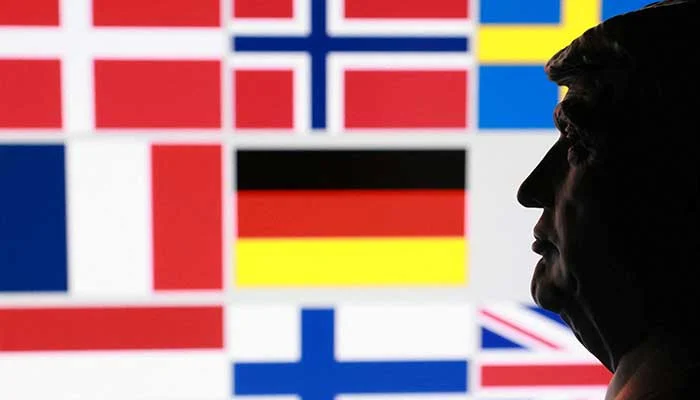
Trump announced on Saturday that starting February 1, he would impose escalating tariffs on Denmark, Sweden, France, Germany, the Netherlands, Finland, the UK, and Norway, unless the U.S. gains permission to buy Greenland. Several major EU nations condemned the move, calling it blackmail.
An urgent EU summit is scheduled for Thursday in Brussels to explore options. One possibility under consideration is a tariff package on $107.7 billion worth of U.S. imports, which could automatically take effect on February 6 after a six-month delay. Another is the activation of the rarely used “Anti-Coercion Instrument” (ACI). This tool could restrict US access to public tenders, investments, banking, and trade in services — especially digital services where the U.S. has a surplus with the EU.
Support seems stronger for the tariff package at this stage, as initial backing for the anti-coercion measures appears mixed, an EU source said.
European Council President Antonio Costa, who presides over EU summits, stated that consultations with EU members underscored their strong support for Denmark and Greenland and their willingness to stand against any coercive pressure. Danish Foreign Minister Lars Lokke Rasmussen, visiting Norway, emphasized that Denmark remains committed to diplomacy, referencing a recent agreement among Denmark, Greenland, and the U.S. to establish a working group. Rasmussen also noted that checks and balances within American society could act as a safeguard against any impulsive decisions.
The EU’s diplomatic efforts to engage in dialogue will likely be a key topic at the upcoming World Economic Forum in Davos, where Trump is scheduled to give a keynote speech, his first appearance in six years. An EU official summarized the EU’s strategy: “All options are on the table—dialogue with the U.S. will continue after Davos.”
Currently, the eight countries targeted by U.S. tariffs have sent small military contingents to Greenland as tensions escalate over the future of Denmark’s Arctic territory. The joint statement issued on Sunday warned that the tariff threats undermine transatlantic relations and could lead to a dangerous spiral. They expressed their willingness to pursue dialogue based on sovereignty and respect for territorial integrity.
Danish Prime Minister Mette Frederiksen expressed reassurance about the continent’s unified stance, reaffirming that “Europe will not be blackmailed.” The tariff disputes unsettled global markets, causing the euro and British pound to decline against the dollar, with increased volatility expected.
Discussions around U.S. trade agreements are also underway. French President Emmanuel Macron is advocating for activating the anti-coercion tool, while Irish Prime Minister Micheál Martin advised caution, suggesting it’s premature to deploy the ACI. Italian Prime Minister Giorgia Meloni, who has closer ties with Trump than some other EU leaders, labeled the tariffs as a “mistake” and said she voiced her concerns to the president earlier Sunday.
The situation puts existing U.S.-UK and U.S.-EU trade deals under scrutiny. These agreements have faced criticism for favoring the U.S., which maintains broad tariffs, while their partners are required to remove import duties. The European Parliament is now considering suspending its work on the EU-U.S. trade deal, especially after postponing a vote that was scheduled for January 26-27.
German lawmakers also hinted at possible last-resort actions, including boycotting the upcoming U.S.-hosted World Cup, to influence the Greenland issue. Meanwhile, the markets remain cautious, with currency values fluctuating amid uncertainty about future trade relations.
 ChatGPT
 Perplexity
 Gemini AI
 Grok AI