Select Language:
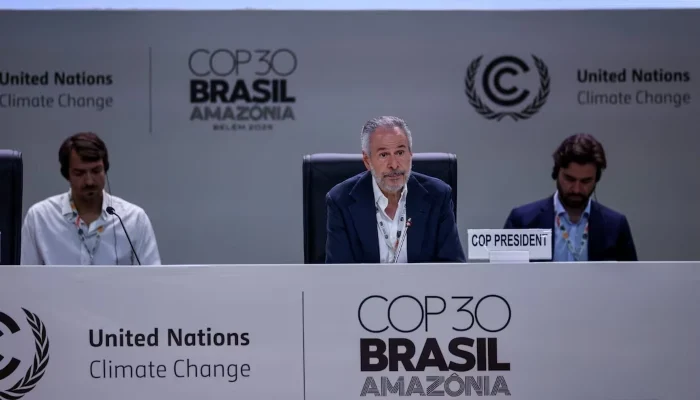
The final results of Brazil’s COP30 climate summit remain uncertain as the European Union refuses to endorse a draft agreement, claiming it doesn’t sufficiently push global efforts to reduce greenhouse gas emissions. The two-week conference in Belem, held in the Amazon, was expected to conclude on Friday evening but extended into the night as negotiations persisted.
Brazil emphasized that this summit was critical for international climate cooperation, urging countries to find common ground on issues like fossil fuel use and to demonstrate that coordinated global action is essential. COP30 President Andre Correa do Lago urged negotiators in a plenary session to unite and reach an agreement, stating, “This cannot be an agenda that divides us. We must reach an agreement together.”
Some developing nations challenged the EU’s stance, demanding more financial support to help poorer countries adapt to climate impacts. A developing country negotiator, speaking anonymously, said, “We can’t simply focus on one pathway. If there’s a pathway for fossil fuels, there needs to be a pathway for climate finance, too.”
Disagreements over fossil fuel policies, emission reduction timelines, and funding highlighted the profound challenge in forging a consensus at this critical climate forum, a recurring test of global resolve to prevent the worst effects of climate change. A draft agreement released early Friday by Brazil omitted any references to fossil fuels, removing earlier options that many countries opposed. Despite initial calls from around 80 nations to phase out fossil fuels, many signaled they’d accept the deal without such commitments by Friday night.
The EU, representing 27 countries, viewed the draft as too weak. EU Climate Commissioner Wopke Hoekstra declared, “Under no circumstances will we accept this.” While the EU is open to increased funding for climate adaptation, it insists the climate emissions sections need strengthening. Some European negotiators considered walking away from the talks over the draft.
Reports indicated that the summit leadership was primarily seeking minor adjustments to the current draft, and the possibility of a separate side agreement on fossil fuels was under discussion—an arrangement countries could choose to join voluntarily, but which would not be part of the formal consensus-based COP agreement.
The Arab group, composed of 22 nations including Saudi Arabia and the UAE, reportedly told negotiators that their energy sectors are off-limits in negotiations. A Saudi representative conveyed that targeting their energy industries would jeopardize the entire process, though the Saudi government did not respond to comment requests.
The draft also aims to triple financing for climate adaptation by 2030 compared to 2025 levels—it remains unclear whether these funds would come directly from wealthy nations, international development banks, or the private sector. To adopt the agreement, consensus among nearly 200 countries is required, making the negotiations complex.
COP30 President Correa do Lago highlighted the importance of showing global unity, especially given the absence of the U.S.—which has downplayed climate change, with former President Trump labeling it a hoax. “The world is watching,” he emphasized.
 ChatGPT
 Perplexity
 Gemini AI
 Grok AI