Select Language:
Tens of millions of Bangladeshis cast their votes in a crucial national election, with early results indicating a close contest between the Bangladesh Nationalist Party (BNP) and Jamaat-e-Islami, as counting commenced on Thursday. The election, the first since the youth-led uprising of 2024 that ousted long-time Prime Minister Sheikh Hasina, saw both coalitions vying for control amid hopes of stability, especially after months of protests disrupted daily life and major industries, including the vital garment sector, the world’s second-largest exporter.
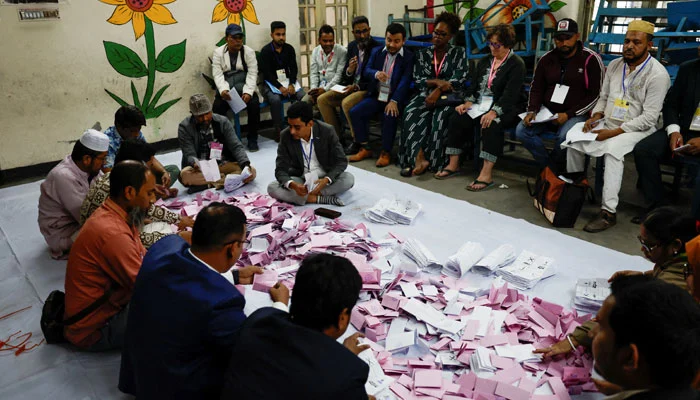
Counting started shortly after polls closed, with trends expected to be clear by midnight and full results by Friday morning, according to officials from the Election Commission. The main contest is between two alliances led by former allies, BNP and Jamaat-e-Islami, with polls suggesting BNP holds a slight lead. Early data shows BNP leading in 10 seats and Jamaat-e-Islami in seven of the nearly 20 most-anticipated constituencies. Bangladesh’s parliament has 300 seats, with 151 needed for a majority.
Voter turnout is on track to surpass the 42% recorded during the 2024 election, with reports indicating that over 60% of registered voters have cast ballots. Both leading candidates—BNP’s Tarique Rahman and Jamaat-e-Islami’s Shafiqur Rahman—expressed confidence in their chances. Rahman told reporters, “I am confident I will win. People are enthusiastic about voting,” while Shafiqur Rahman called this election a “turning point” for Bangladesh and emphasized the public’s desire for change.
Opposition leader Sheikh Hasina’s Awami League has been banned from participating, and she remains in exile in India, an ally of Bangladesh. This situation has opened avenues for Chinese influence amid strained relations between Dhaka and New Delhi. Critics say elections under Hasina have often been marred by boycotts and intimidation. She dismissed the current vote as a “carefully planned farce,” accusing it of lacking genuine voter participation and claiming her supporters rejected the process. She called for the election’s cancellation, the lifting of bans on the Awami League, and the restoration of voting rights under an impartial caretaker government.
Alongside the ballots, a referendum on constitutional reforms was held, focusing on establishing a neutral interim government, restructuring parliament into a bicameral system, increasing women’s representation, bolstering judicial independence, and limiting prime ministers to two terms. More than 2,000 candidates, including many independents, vied for office, marking a record number of parties contesting. Voting was postponed in one constituency due to a candidate’s death.
Security was heightened but no major violence was reported. Approximately 958,000 personnel from police, military, and paramilitary units were deployed nationwide, with most polling stations guarded by armed forces. Voters described the atmosphere as freer and more celebratory than previous elections. For example, Mohammed Jobair Hossain, 39, expressed excitement about voting freely after 17 years and said, “Our votes matter and have significance.” Other voters in Dhaka noted the election felt festive, with some polling places displaying messages such as “Vote without fear” on mounted police horses.
 ChatGPT
 Perplexity
 Gemini AI
 Grok AI