
Select Language:
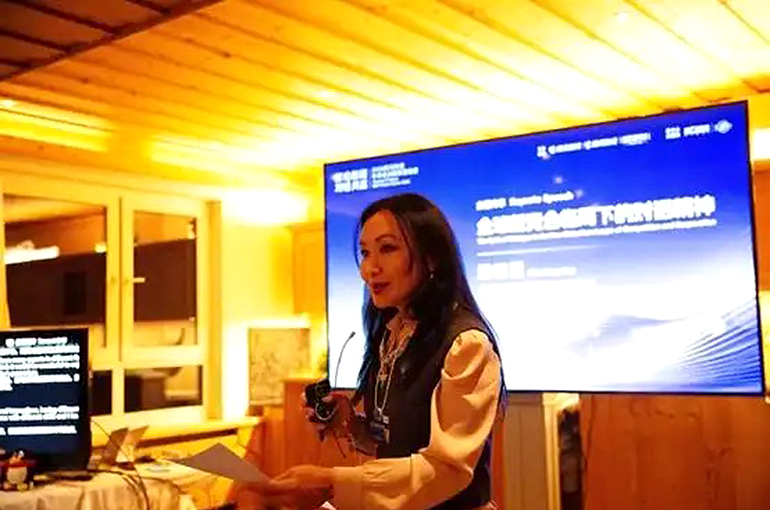
Countries should steer clear of narrow perspectives and instead foster a culture of open dialogue, according to Gim Huay Neo, managing director and chair for China at the World Economic Forum’s governing board.
“The polarization we see in the world today is largely because the space for meaningful conversation has become limited or confined to echo chambers that cater to our own comfort zones,” Neo stated at the Tencent Finance WEF Vision Dinner 2026 in Davos, hosted by a major Chinese tech company on January 21, with media coverage provided by a prominent international news outlet.
Narrowcasting, the opposite of broad broadcasting, describes the trend where individuals rely solely on their own selective media and information sources. Social media has only intensified this tendency, Neo explained.
“To encourage open dialogue is to open up the conversation space, allowing us to hear from people with very different perspectives,” she added.
Despite concerns about increasing fragmentation, Neo emphasized that cooperation remains vital. “Contrary to what some believe, cooperation is not declining,” she pointed out. She also highlighted that the nature of partnerships is evolving, noting a shift from traditional multilateralism to what she calls “minilateralism.”
Minilateralism involves smaller, more focused coalitions working together. Neo described it as a reflection of a highly fragmented world, emphasizing that “coalitions of like-minded groups can collaborate effectively for the greater good.”
She sees minilateralism as a catalyst for business growth, trade, and investment, but also as a means to bring together courageous and purpose-driven organizations to tackle pressing global challenges—environmental issues, social concerns, and health crises—and to find innovative solutions for humanity’s future.
 ChatGPT
 Perplexity
 Gemini AI
 Grok AI