Select Language:
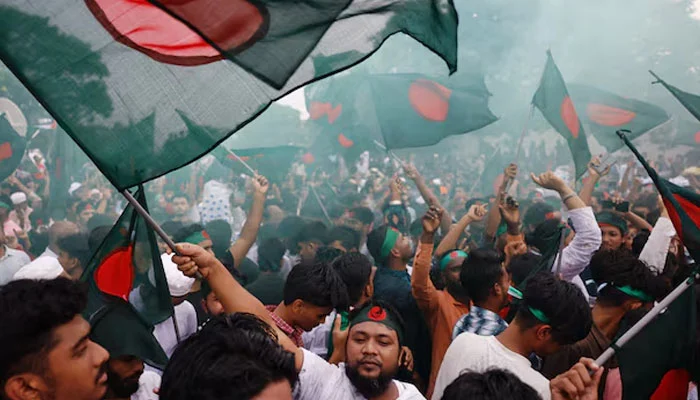
People wave flags during celebrations marking the one-year anniversary of student-led protests that resulted in the removal of Bangladeshi former Prime Minister Sheikh Hasina. The event took place on Manik Mia Avenue, outside the parliament building in Dhaka, Bangladesh, on August 5, 2025. — Reuters
During a conversation about Bangladesh’s political climate with journalists from Bangladesh, Pakistan, and India in Dhaka, I was reminded of how history often seems to repeat itself.
In 2024, India is dealing with the fallout from its earlier miscalculations in Dhaka, while Pakistan is finding new diplomatic opportunities. Whether this signifies a break from the past or just its continuation remains uncertain.
A young Bangladeshi’s remark caught my attention: “We want equal and better relations with both Pakistan and India. Both of you have treated us similarly. We carry wounds from both, but we want to move forward.”
After Sheikh Hasina traveled to India on August 5, 2024, anti-Indian sentiments still run deep among the people, but they are directed at the Indian government rather than Indian citizens. Bangladesh shares a 4,096-kilometer border with India.
There are 54 rivers connecting the two nations, including the Padma, Brahmaputra, and Teesta. Bilateral trade is valued between $14 billion and $16 billion, and their interests remain closely linked.
India’s strategy of heavily relying on Hasina’s Awami League proved to be a costly mistake, though there are signs of effort to repair relations now. India appears to have recognized its policy errors or at least acknowledged that the Bangladesh Nationalist Party (BNP) now holds a clear public mandate.
When I asked the incoming Prime Minister Tarique Rahman if he would seek Sheikh Hasina’s extradition from India due to public calls in Dhaka for accountability, he responded cautiously, “That depends on the judicial process.”
Rahman seems to be a seasoned and cautious politician. He avoids inflammatory language and refrains from criticizing the Awami League or Sheikh Hasina.
An encouraging sign is that Pakistan appears to have an open door in Dhaka. Locals warmly welcome Pakistanis. I met Afroza Begum, whose father served in the Pakistani Air Force; she was born in Rawalpindi in 1958.
She recalled how she and her siblings were detained after Matiur Rahman attempted to hijack a Pakistani plane. Despite these memories, she also cherishes fond moments—especially the food and landmarks of Karachi and Peshawar.
“We moved from Pakistan in 1974, but our hearts remain there,” she said. “When we heard about the Peshawari Kitchen restaurant here in Dhaka, we just had to come back to relive those days.”
Pakistani diplomats, including former High Commissioner Imran Siddiqui, have been actively working to improve relations. The current High Commissioner Imran Haider and his team are focusing on strengthening both social and economic ties. Bilateral trade has grown to approximately $865 million.
Pakistani policymakers should view Bangladesh as an independent, sovereign nation with its own international relationships, rather than through the lens of India. Likewise, Indian policymakers should see Bangladesh as a country that helped create SAARC and now aims to revive it, not as a pawn in regional rivalries.
Tarique Rahman stated at a press conference that Bangladesh will seek to reorganize SAARC and plans to engage with regional partners once his government is formed—highlighting that this was Bangladesh’s initiative.
For Bangladesh’s new leadership, the main focus is the country’s own interests. Rahman emphasizes a “Bangladesh First” approach, rather than prioritizing ties with Pakistan or India. Despite personal hardships—including the assassination of his father and his mother’s death after years in exile—he chooses to avoid criticizing political opponents.
Domestically, he is reaching across divides—meeting with figures like Dr. Shafiqur Rahman of Jamaat-e-Islami Bangladesh and Nashad Islam, a prominent youth leader of the National Citizens Party (NCP), which played a significant role in Sheikh Hasina’s ousting.
He seems to grasp that rebuilding a nation requires respecting political adversaries. His hope is that by reinforcing SAARC, Bangladesh can evolve into a hub for regional cooperation instead of a battleground for India-Pakistan tensions.
Originally published in The News.
 ChatGPT
 Perplexity
 Gemini AI
 Grok AI