Select Language:
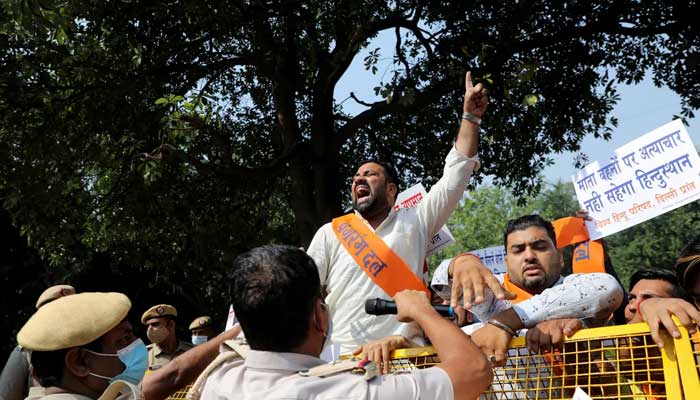
A large protest took place outside the Bangladesh High Commission in New Delhi, organized by the ‘Akhand Hindu Rashtra Sena’. Authorities responded by setting up barricades and controlling access, while some individuals were permitted to carry out activities near the embassy perimeter. The Dhaka government condemned India’s stance on the matter, labeling the protest as “unjustifiable” and “highly regrettable,” and emphasized that the incident could not be dismissed as “misleading propaganda,” contrary to claims made by India’s Ministry of External Affairs (MEA).
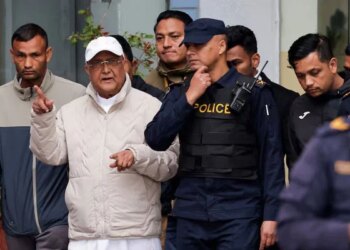
The Bangladesh Foreign Ministry detailed how the protesters were allowed to gather right outside the embassy, causing alarm among staff members inside. The demonstration occurred amid heightened tensions following the murder of Sharif Osman Hadi, a prominent student leader in Bangladesh. Hadi, aged 32, was shot in Dhaka by masked assailants while campaigning for elections. He was a vocal member of the Inquilab Mancha and had participated in protests that ousted the current government.
In response, the Indian MEA spokesperson Randhir Jaiswal stated that police dispersed the protesters within minutes and denied any attempt to breach security. He also accused certain segments of the Bangladesh media of spreading “misleading propaganda,” asserting that around 20-25 youths had gathered peacefully outside the High Commission. India reaffirmed its commitment to protecting foreign diplomatic missions on its soil and stated that officials were monitoring the situation in Bangladesh closely, having conveyed strong concerns over attacks on minority communities.
However, Bangladesh officials clarified that protesters chanted anti-Bangladesh slogans and issued threats against the High Commissioner, M Riaz Hamidullah. They also noted they were not given prior notice about the demonstration, which they characterized as an organized event. The Bangladeshi government rejected India’s framing of the incident as an isolated attack on a Hindu citizen, emphasizing it was part of a broader pattern of violence against minorities.
The protest unfolded against the backdrop of widespread unrest in Bangladesh triggered by Hadi’s killing. His death in Dhaka sparked rallies and violent incidents, including assaults on the Indian Consulate in Chittagong and attacks on local media outlets. Critics have accused certain publications of showing favoritism toward India, especially since Bangladesh’s former Prime Minister Sheikh Hasina has sought refuge in India following political upheavals in Dhaka.
 ChatGPT
 Perplexity
 Gemini AI
 Grok AI