
Select Language:
For over a hundred years, biology textbooks have described vertebrate vision—including humans—as relying on two distinct cell types: rods for low-light conditions and cones for daylight and color perception. However, recent research on deep-sea fish reveals that this clear-cut classification may be oversimplified.
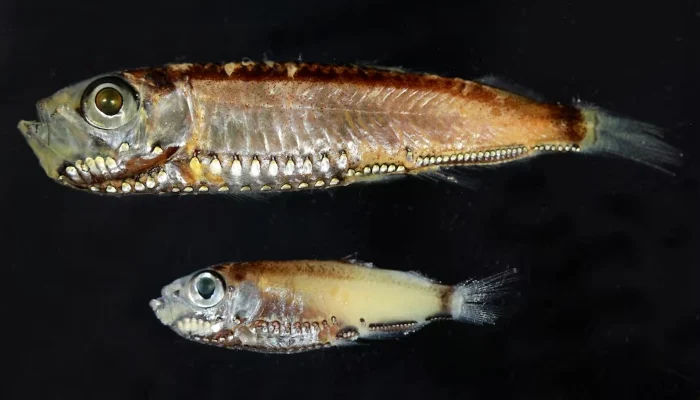
Scientists have discovered a new kind of photoreceptor in deep-sea fish eyes, one that combines the structural characteristics of rods with the molecular machinery and gene expression typically associated with cones. This hybrid cell type was observed in the larvae of three species from the Red Sea.
The species examined include Maurolicus mucronatus (a hatchetfish), Vinciguerria mabahiss (a lightfish), and Benthosema pterotum (a lanternfish). The hatchetfish retains these hybrid cells throughout its life, whereas the other two species transition to the traditional rod-cone arrangement as adults.
All three are relatively small, with adult sizes ranging from 1 to 3 inches (3 to 7 centimeters), and their larvae are even tinier. They occupy a twilight zone of the ocean, where sunlight barely reaches the depths.
The vertebrate retina is a sensory layer at the back of the eye responsible for light detection and signal conversion into neural impulses. It mainly contains two types of photoreceptive cells: rods, which are elongated and specialized for capturing as much light as possible, and cones, which facilitate color vision and finer detail.
Lily Fogg, a marine biology researcher at the University of Helsinki and the study’s lead author, explained, “Rods and cones shift their positions within the retina when transitioning between dim and bright environments, which is why our eyes need a moment to adjust when switching from darkness to light.”
In the study, researchers examined the retinas of fish larvae collected at depths ranging from 65 to 650 feet (20 to 200 meters). These creatures live in a low-light environment where neither traditional rods nor cones function optimally. In response, they appear to have developed an evolutionary solution.
“Our findings challenge the long-held belief that rods and cones are entirely separate, fixed cell types,” Fogg said. “Instead, photoreceptors can exhibit a combination of structural and molecular features, demonstrating a remarkable flexibility and adaptability in vertebrate visual systems.”
Senior author Fabio Cortesi, a marine biologist and neuroscientist at the University of Queensland, added, “It’s exciting to see that biology doesn’t always fit neatly into predefined categories. I wouldn’t be surprised if these hybrid cells are more widespread among vertebrates, including land animals.”
The studied fish species produce bioluminescent light via small organs on their bodies, often located on the underside. They emit a blue-green glow that blends with the faint sunlight filtering through the water—a camouflage strategy known as counterillumination, used to evade predators.
“Small marine fish like these form the foundation of oceanic food webs,” Cortesi noted. “They are abundant and serve as prey for larger fish such as tuna and marlin, marine mammals like dolphins and whales, and seabirds.”
Additionally, these fish undertake one of the ocean’s most significant daily migrations. At night, they swim near the surface to target plankton-rich waters for feeding, then retreat to depths of 650 to 3,280 feet (200 to 1,000 meters) during the day to avoid predators.
“The deep sea remains largely unexplored, like a mysterious frontier filled with potential for groundbreaking discoveries,” Cortesi emphasized. “We need to protect this environment to ensure future generations can continue exploring and appreciating its wonders.”
 ChatGPT
 Perplexity
 Gemini AI
 Grok AI