Select Language:
Several residential high-rise towers were engulfed in flames. Firefighters are struggling to reach residents who may be trapped inside. Authorities indicate that foam and scaffolding mesh might have played a role in the fire’s spread.
Hong Kong officials announced on Thursday that the death toll has risen to at least 75 in the city’s most devastating fire in decades. Fire crews continue to search through charred high-rise buildings at an apartment complex for numerous missing individuals. The flames were still visible in some of the estate’s nearly 2,000 units more than 24 hours after the fire started, with firefighters still spraying water on the blackened exteriors.
Investigations into the cause of the fire—Hong Kong’s worst in nearly 80 years—are underway. Officials are examining whether bamboo scaffolding and plastic mesh used in extensive renovations around the estate contributed to the disaster. The city’s anti-corruption agency has launched a probe into the renovation activities, following the arrest of three men suspected of negligently leaving foam packaging at the scene.
Residents of Wang Fuk Court in Hong Kong’s Tai Po district reported that they did not hear any fire alarms and had to notify neighbors door-to-door. “The fire spread so quickly. I saw one hose trying to save several buildings, but it was far too slow,” said a man surnamed Suen. “We were ringing doorbells, knocking on doors, and alerting everyone to evacuate—that’s what the scene was like.”
By Thursday afternoon, fire officials announced that four of the eight apartment buildings had their fires extinguished, with three others now under control. One building was unaffected.
Pope Leo expressed his condolences, issuing a statement to send “spiritual solidarity to all those suffering,” especially the injured and grieving families.
As of 8 p.m. local time (1200 GMT), 65 people had been confirmed dead, including a 37-year-old firefighter and two Indonesian migrant domestic workers. This incident marks Hong Kong’s deadliest fire since 1948, when explosions and subsequent fires killed 135 people.
The number of missing persons remains high; early Thursday, city leader John Lee stated 279 people were unaccounted for. However, firefighters later reported that some of those individuals have been contacted. No updated figures have been provided since.
At a nearby community center, authorities displayed photos of victims pulled from the wreckage for identification. “If the faces are unrecognizable, we have personal items to help identify them,” said a woman surnamed Cheung, searching for relatives. “I can’t describe my feelings. There were children… I just can’t find the words.”
A government spokesperson reported that, among hospital patients, 12 are in critical condition, 29 are serious, and 17 are stable. Fires of this severity were once common in Hong Kong, especially in poorer neighborhoods, but improved safety protocols have greatly reduced their frequency.
Following the disaster, Hong Kong officials announced immediate inspections of all large-scale renovation projects on housing estates. City leader Lee emphasized the importance of transitioning to metal scaffolding, stating the government would work with the construction industry to accelerate this process.
Chinese President Xi Jinping offered condolences, with state media noting that Beijing would provide assistance such as drones and medical supplies. The government is also organizing temporary housing and emergency funds for displaced residents. Activities related to Hong Kong’s upcoming legislative elections, scheduled for December 7, have been suspended.
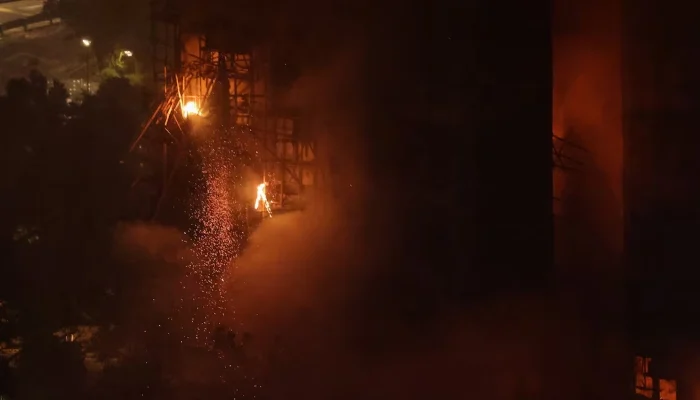
Late Wednesday, scenes of destruction included charred scaffolding collapsing and flames erupting from windows into the night sky. Wind and debris are believed to have contributed to the fire spreading across multiple buildings. Over 900 residents sought shelter in temporary accommodations overnight. Some evacuees were allowed to return home Thursday afternoon, and volunteers distributed clothing, meals, and information about missing persons.
In the aftermath, the community gathered near the complex in a spontaneous effort to support displaced residents and firefighters, demonstrating the city’s resilient spirit. “It’s truly touching. When one of us is in trouble, everyone offers help… It shows the kindness of Hong Kong people,” said Stone Ngai, one of the aid organizers.
 ChatGPT
 Perplexity
 Gemini AI
 Grok AI