Select Language:
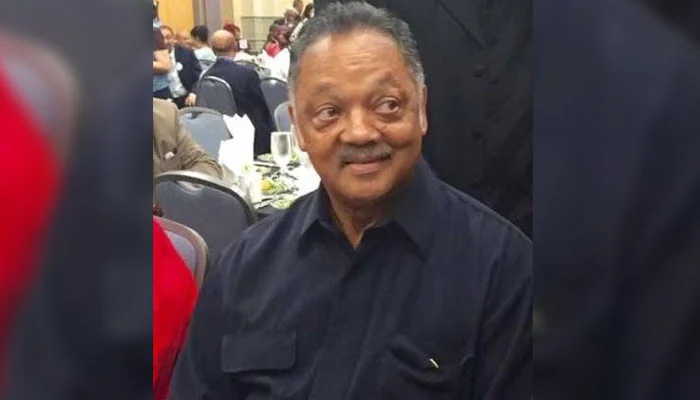
Reverend Jesse Louis Jackson Sr., a prominent figure in American politics and a resilient voice of the civil rights movement, has passed away at age 84.
His death marks the loss of a leader whose voice for over sixty years championed racial equality, economic justice, and religious liberty across the United States.
A key player in the civil rights struggle, Jackson was closely associated with Dr. Martin Luther King Jr. and participated in pivotal protests advocating for voting rights and racial justice. Following King’s assassination in 1968, Jackson stepped up to help sustain the movement’s moral and political momentum.
He established Operation PUSH and later the Rainbow Push Coalition to broaden economic opportunities and political engagement for African Americans, Latinos, workers, the impoverished, and marginalized communities.
Jackson made two bids for the Democratic presidential nomination in 1984 and 1988. While he didn’t secure the nomination, his campaigns significantly influenced the party’s political landscape and expanded the electorate. His rallying cry, “Keep Hope Alive,” transcended campaign slogans to become a moral statement emphasizing hope as the vital force behind democracy.
His activism extended beyond African American issues. Jackson was an outspoken supporter of Arab and Muslim American civil rights, especially amid moments of national tension. In 2010, during debates over the proposed Islamic community center near Ground Zero in New York, he defended the project, asserting that religious freedom is a core American principle that must be protected from fear. He warned that restricting religious rights jeopardizes the democratic fabric for all.
In 2011, at a CAIR-Chicago event, Jackson reiterated his solidarity with Muslim Americans, emphasizing that justice is not dictated by religion. Later, in 2015, when proposals for mandatory ID cards for Muslims and rhetoric against refugees surfaced, Jackson joined Muslim demonstrators in suburban Chicago, cautioning that such policies echoed historic acts of discrimination. For him, defending civil rights meant advocating for any community facing prejudice and exclusion.
His support for Muslim Americans was also evident at the 2016 Democratic National Convention, where he praised their active civic participation and stressed their essential role in American democracy, underscoring that true democracy depends on full representation of all communities.
Internationally, Jackson spoke out against apartheid in South Africa, negotiated for the release of prisoners and hostages in Cuba and the Middle East, and pushed corporations to embrace diversity and equal opportunity. Despite receiving the Presidential Medal of Freedom, what defined him was his unwavering moral courage in confronting injustice.
Leaders around the world have described Jackson as a symbol of human dignity, inclusion, and resilience. His greatest legacy arguably lies in his efforts to break down barriers of race, religion, and class, affirming that democracy is more than just majority rule; it’s about participation and equality for everyone.
In reflecting on his passing, Muslim community leaders expressed a deep sense of loss. They pointed out that the world has lost a steadfast advocate for human rights—a voice that championed the vulnerable and refused to accept injustice.
 ChatGPT
 Perplexity
 Gemini AI
 Grok AI