Select Language:
A team of researchers at Tsinghua University in China has developed an innovative virtual drug screening platform powered by artificial intelligence, capable of operating up to 10 million times faster than traditional molecular docking techniques. This breakthrough allows for genome-wide drug discovery at an unprecedented pace.
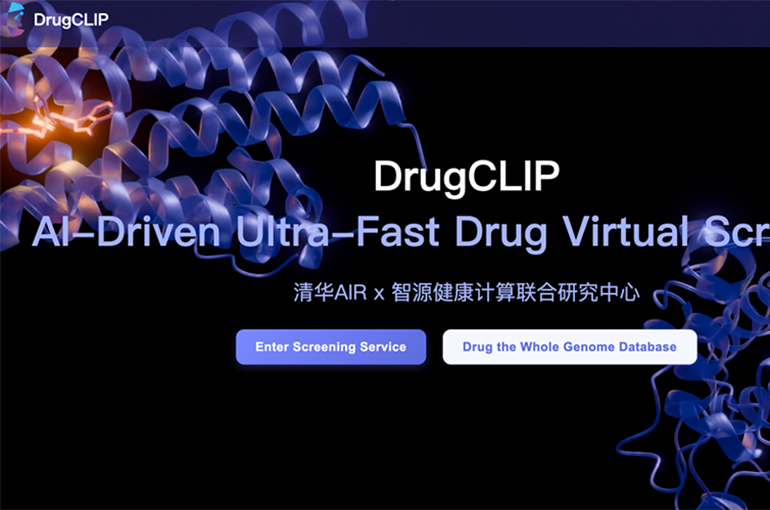
Led by Lan Yanyan from the university’s Institute for AI Industry Research, the team created DrugCLIP—a contrastive learning-based framework designed for swift and precise virtual screening. This platform can perform trillions of screenings across the entire human druggable proteome and offers an openly accessible resource that paves the way for next-generation drug development. The findings were published in a recent issue of the academic journal Science.
Currently, roughly only 10 percent of the known druggable targets in the human body are explored through targeted drug development. Consequently, scientists have increasingly relied on AI tools to identify potential candidates and accelerate the development process. For instance, Google’s DeepMind has revolutionized protein structure prediction with AlphaFold. However, these tools remain too computationally demanding to encompass the entire genome’s targets.
DrugCLIP overcomes this computational challenge by encoding protein binding sites and small molecules into a shared latent space. The system is trained using a combination of large synthetic datasets and experimentally determined protein-ligand structures. This approach allows large compound libraries to be swiftly searched against target proteins employing dense retrieval techniques similar to those used in modern search engines.
To demonstrate its capabilities, the research team performed a genome-wide virtual screening involving approximately 10,000 human proteins and 500 million compounds. The platform evaluated over 10 trillion protein-ligand pairs in less than 24 hours, utilizing just eight graphics processing units. The screening yielded more than 2 million potential molecules across nearly 20,000 binding pockets, representing about half of the human genome.
Building on these achievements, the team launched GenomeScreenDB, the world’s largest database for protein-ligand screening. This resource is freely available to the global research community and aims to support fundamental research and early-stage drug discovery efforts.
 ChatGPT
 Perplexity
 Gemini AI
 Grok AI