Select Language:
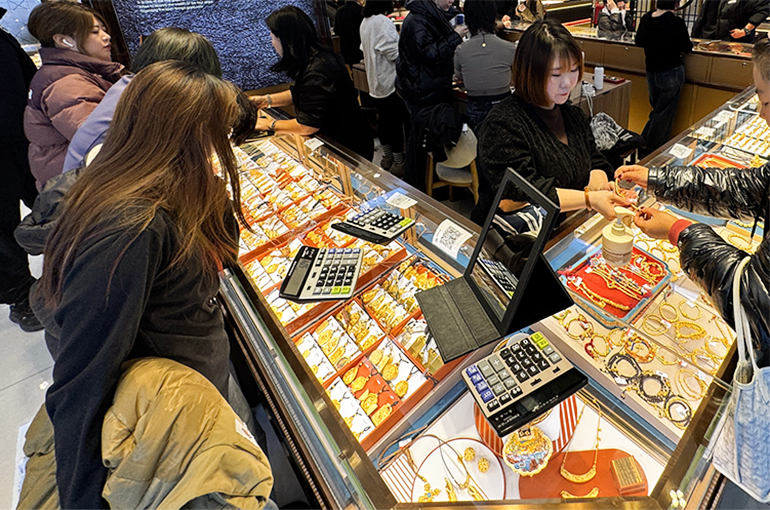
Chinese jewelry stores are increasing their gold product prices as the country’s banks tighten risk management measures around retail gold sales amidst rising precious metal prices fueled by escalating Middle East tensions.
Most Chinese jewelry retailers saw their gold prices surpass 1,600 yuan (approximately $233) per gram on February 28, the day the US and Israel conducted airstrikes on Iran. This represented an increase of more than 30 yuan ($4.40) from the day before. Laopu Gold, a prominent brand, adjusted its gold prices for the first time this year, raising them by 20 to 30 percent on that day.
In London, spot gold hovered near $5,180 per ounce on February 27 before climbing sharply toward the close, finishing above $5,278, according to market data. The rally continued into the following trading session, opening roughly 2.2 percent higher at around $5,393.
Gold bar supplies of investment grade have become more limited in China. All “Ruyi” gold bars, a bullion line produced by the Industrial and Commercial Bank of China, were sold out as of yesterday, according to major state-owned bank apps.
In response to short-term market volatility, several banks issued warnings. China Zheshang Bank stated on February 28 that recent geopolitical tensions and economic policies have caused increased volatility in gold prices, heightening the overall risk for investors. The bank warned that if sharp price swings, liquidity shortages, or declines in trading volume persist, it may temporarily halt trading in its Wealth Gold Accumulation products.
Other lenders have also reassessed gold investments as medium-risk. For instance, China Merchants Bank now categorizes its personal gold account offerings as medium risk (R3 rating) and requires clients to undergo a risk assessment before opening an account.
Industry insiders suggest that short-term gold price movements will largely depend on how the conflict in the Middle East evolves, including its scope and duration. Over the longer term, the influence of geopolitical tensions is expected to ease, helping markets stabilize and trading to become more rational.
The extent of Iran’s response and the potential spread of conflict to regions like Lebanon or the Red Sea—disrupting shipping routes and energy supplies—could significantly boost gold prices. This would be driven by increased safe-haven demand and rising inflation expectations, according to industry analyst Wang Weimang from Zhonghui Futures.
 ChatGPT
 Perplexity
 Gemini AI
 Grok AI