
Select Language:
Freight shipments from China to Vietnam and Laos by train saw a notable increase last year, primarily fueled by the strengthening trade relations between China and the Association of Southeast Asian Nations.
Freight trains departing from the southern Guangxi Zhuang Autonomous Region heading to Vietnam carried a record 37,000 twenty-foot equivalent units of goods in 2025, marking an 86% rise compared to the previous year, according to data released by the China Railway Nanning Bureau Group yesterday.
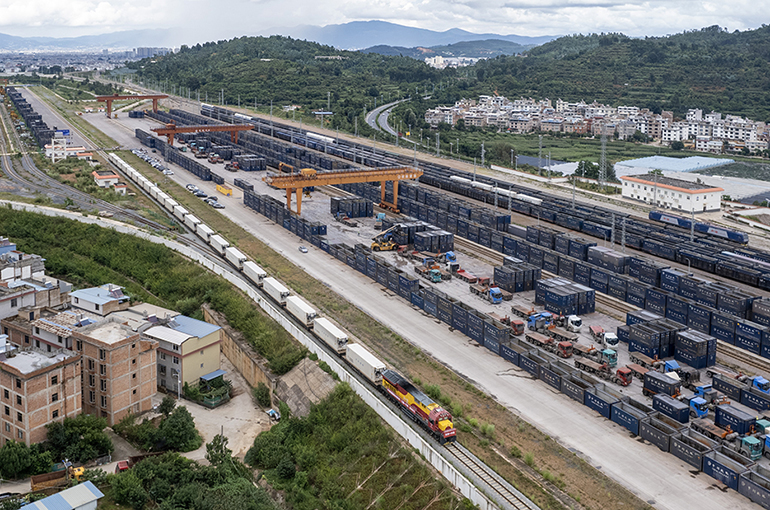
Cross-border freight on the China-Laos Railway, connecting Kunming in Yunnan province with Vientiane, jumped 18% to 5.5 million tons. Overall cargo transported along the railway surged 25% to 24.5 million tons, with passenger numbers increasing slightly by 2% to 19.5 million, as announced by the China Railway Kunming Bureau Group on the same day.
The rapid growth in rail freight between China and ASEAN nations is largely attributed to tariff reductions enabled by the Regional Comprehensive Economic Partnership (RCEP) and the China-ASEAN Free Trade Area 3.0 Upgrade Protocol, which have significantly lowered cross-border trade costs, explained Hao Panfeng, deputy secretary-general of the China Container Industry Association.
Hao also noted that ongoing improvements in railway infrastructure will further boost trade opportunities between China and ASEAN countries. For example, the opening of the rail link between China and Thailand is expected to diversify the range of goods traded.
Since its launch in 2017, container trains on the China-Vietnam Railway have increased from just three trains weekly to 14 last year, driven by soaring trade demand. The carrying capacity per train has also risen from 1,000 tons to 1,300 tons.
The China-Laos Railway, spanning 1,035 kilometers, began operations in December 2021. In its first four years, it has transported 62.5 million passengers and 72.5 million tons of goods, including over 16 million tons of cross-border freight.
Construction of the China-Thailand Railway commenced in 2017, with the first phase expected to be completed by 2028 and the second phase opening around 2030. This railway will connect with the China-Laos Railway to form a high-speed corridor linking Kunming to Bangkok.
 ChatGPT
 Perplexity
 Gemini AI
 Grok AI