
Select Language:
Consumer prices in China saw their largest increase in 20 months in November, primarily fueled by rising food costs.
The consumer price index rose by 0.7 percent last month compared to the same period last year, reaching its highest level since March 2024, according to data released today by the National Bureau of Statistics. This marks an increase from the 0.2 percent rise recorded in October.
According to Dong Lijuan, a senior statistician at the bureau, the rise in inflation was largely driven by escalating food prices.
Food prices experienced their first climb in ten months in November, increasing by 0.2 percent after falling 2.9 percent in October. This change shifted their impact on the consumer price index from a decrease of 0.54 percentage points to a slight increase of 0.04 points.
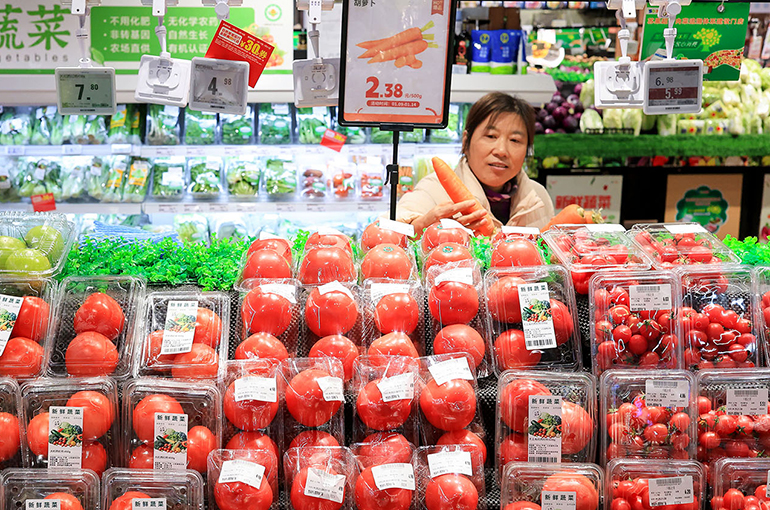
The cost of fresh vegetables surged 14.5 percent following a 7.3 percent decline in the previous month, breaking a nine-month downward trend and adding approximately 0.49 percentage points to the year-over-year rise in consumer inflation compared to October.
Fresh fruit prices turned positive, rising by 0.7 percent after a 2 percent decrease. Pork and poultry prices continued to fall but the declines narrowed, dropping 15 percent and 0.6 percent respectively.
The core consumer price index—excluding food and energy—climbed 1.2 percent, marking the third consecutive month it has remained above 1 percent.
Zhang Yu, chief macro analyst at Huachuang Securities, explained that favorable weather conditions last year supported vegetable growth, resulting in a low comparison base. However, since mid-October this year, cooler temperatures and heavy seasonal rainfall have caused frost and flood damage, constraining the supply of certain vegetables, Zhang noted.
Due to this low base effect, government policies aimed at stimulating consumption, and efforts to curb excessive competition (involution), analysts expect the consumer price index to rise each month, averaging around 0.7 percent over the quarter, as stated by Wu Chaoming, chief economist at Hunan Chasing Financial Holdings.
The producer price index, which measures industrial profits, decreased for the 38th consecutive month in November, according to the same data. The PPI fell by 2.2 percent from the previous year, slightly worse than the 2.1 percent decline in October, mainly reflecting last year’s higher comparison base.
While factors such as the base effect, anti‑involution measures, and new fiscal support are encouraging inflation expectations for the fourth quarter, external demand weaknesses, tariff tensions, and ongoing domestic issues in stabilizing the property market and employment are likely to keep CPI and PPI growth modest, Wu added.
Stronger demand-focused policies would be necessary to push prices higher, Wu indicated.
 ChatGPT
 Perplexity
 Gemini AI
 Grok AI